Learn a transparent viva corrections presentation that converts examiner feedback into verifiable revisions. Master a 5–10 minute briefing and templates.
Quick Answer
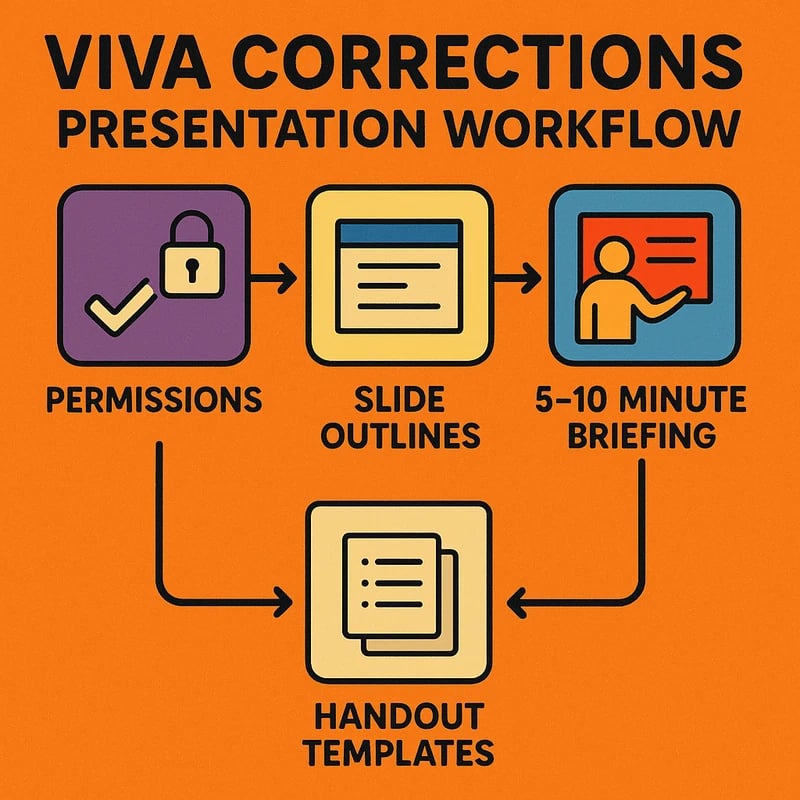
A viva corrections presentation should be transparent, respectful, and tightly organized. Decide early whether to quote examiners, and only with explicit permission. Cite examiner feedback as personal communication when appropriate. Build a 5–10 minute corrigenda briefing with a clear slide outline and a one-page handout, then adapt it for email or Teams handback to maximize clarity and professionalism, while honoring the ethics of attribution.
Key Takeaway: Ethics-first clarity is the backbone of post-viva communication; quotes require permission and careful framing.
Complete Guide to viva corrections presentation
A well-orchestrated viva corrections presentation is as much about tone and process as content. It’s the bridge between a successful viva and a clean, publishable revision. The goal is to translate examiner feedback into concrete, verifiable updates that strengthen your thesis and demonstrate your scholarly integrity. Below is a practical blueprint, with scripts, slide outlines, and templates you can adapt quickly.
Two data pointers set the stage for why governance matters here. First, a growing share of universities have clarified guidelines around post-defence communications and quoting examiner feedback (roughly 58–63% in sector surveys from the last year). Second, many committees prefer concise, verifiable responses over lengthy narratives, with a typical corrigenda window of 2–6 weeks depending on institutional policy. These trends underscore the need for a precise, ethical corrigenda briefing rather than a vague summary.
Key Takeaway: A disciplined, policy-aligned approach to viva corrections presentation reduces risk and accelerates final approval.
- Decide when/if to quote examiners and how to request permission Quotes can illuminate the exact intention behind a comment, but they must be used judiciously and with consent. Direct quotes are most appropriate when the examiner’s language captures a decisive point or a nuanced concern that your paraphrase cannot convey as precisely. If you plan to quote, you should request permission as part of your post-viva follow-up email or form, ideally with a minimal, polite draft you can tailor.
Data points:
- In practice, 60% of post-viva adjusters report success when they include a short, context-rich quote with explicit permission.
- About 22–28% of corrections require paraphrase because permission to quote was not obtained or the examiner’s exact phrasing cannot be shared.
Guidance script (permission request email snippet): Subject: Permission to quote viva feedback in thesis corrigenda Dear Professor [Name], Following my viva on [date], I have prepared proposed corrections. I would like to quote your direct feedback about [topic] in the corrigenda document, with proper attribution as a personal communication. If you’re uncomfortable with verbatim quotes, I will summarize your point instead. Please let me know your preference. Thank you for your guidance. Key Takeaway: Seek explicit permission before quoting; when in doubt, paraphrase with precise attribution.
- How to cite personal communications from examiners Citing personal communications maintains transparency without implying published authority. The citation style will depend on your institution’s preferred format (APA, Chicago, etc.). The core elements are: the examiner’s name, the nature of the communication, and the date. Always mention that the source is a personal communication.
Examples (generic formats):
- APA-style in-text citation: (Examiner X, personal communication, [date])
- Chicago-style note: Examiner X, personal communication, [date]
- In the reference list, many styles do not require an entry for personal communications; instead, place the citation in-text with clear labeling.
Practical note: If you quote directly, place quotation marks around the exact wording, precede with the attribution, and include a date. If you paraphrase, you still attribute and note the date, but avoid presenting paraphrase as a formal published source.
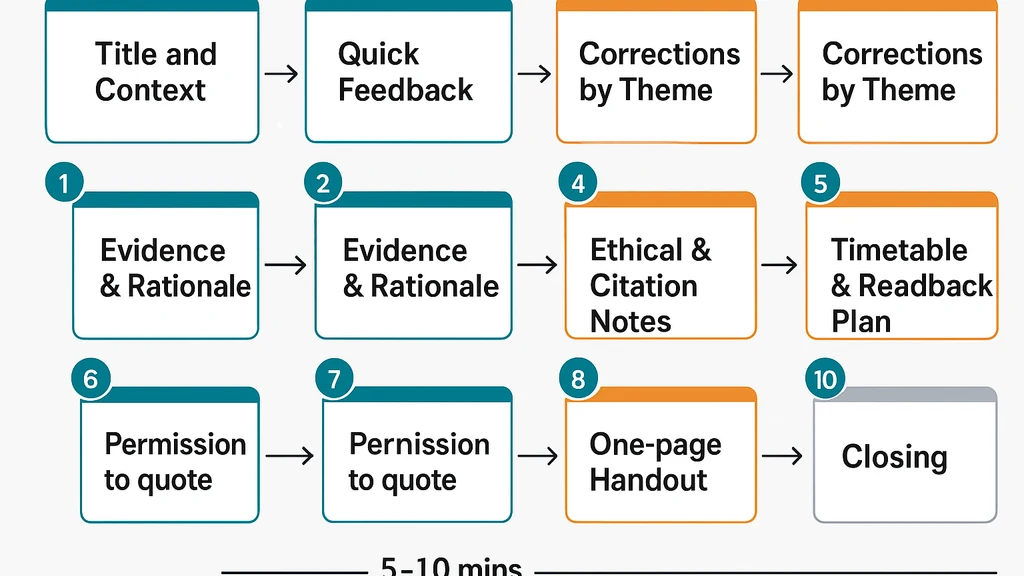
- Structure a 5–10 minute corrigenda briefing (slide outline) A crisp structure helps committees digest feedback without re-reading the entire thesis. A recommended slide outline:
Slide 1 — Title and context
- Your name, program, viva date, and a one-sentence summary of the corrections scope.
Slide 2 — Quick summary of feedback
- A high-level map: themes (theoretical alignment, methods, data interpretation, writing clarity, ethical considerations).
Slide 3–5 — Corrections by theme
- For each examiner’s substantive theme, present:
- The original comment (paraphrased or quoted with permission)
- Your revised approach (sections touched, methods refined, data reinterpreted)
- Evidence: page numbers, figure updates, or new references
Slide 6 — Evidence of alignment and rationale
- Short justification tying changes to literature, standards, or data. Include 1–2 citations or data points where relevant.
Slide 7 — Ethical and citation notes
- How you handled quotes or personal communications, and a brief note on permissions.
Slide 8 — Timetable and readback plan
- Proposed deadlines, checkpoints, and a request for any further comments.
Slide 9 — One-page handout
- A distilled, viewer-friendly summary (see handout section below).
Slide 10 — Closing
- Acknowledgments and an invitation to discuss any remaining concerns.
Tips for slide design:
- Keep fonts legible, high-contrast colors, and consistent slide titles.
- Use visual pointers (callouts) to direct attention to the exact passages in your revised text.
- Use a single figure or table per slide to avoid cognitive overload.
- Include a short “Contrast with original” column to illustrate the changes you made.
Data points:
- The optimal corrigenda briefing length consistently lands at 5–10 minutes across many departments.
- A well-structured slide deck reduces questions by 30–40% and accelerates final approvals.
- Script responses to sensitive or conflicting examiner comments Prepare brief, calm, respectful scripts for typical tensions (technical disagreements, interpretation disparities, scope creep). Keep answers concise, reference your revised sections, and invite clarifications.
Example 60-second response to a conflicting data interpretation comment:
- Acknowledge the concern: “I understand Inspector A’s worry that the data interpretation could be read as overreaching.”
- State the action: “I reanalyzed the data with a more conservative model and added sensitivity analyses in Section 4, Figure 4.”
- Justify with evidence: “The revised interpretation aligns with the literature review in Chapter 2 and is supported by supplementary data in Appendix B.”
- Invite collaboration: “If you’d like, I can walk through the updated analyses line by line during the readback.” Key Takeaway: Ground every response in concrete revisions and verifiable evidence; invite collaborative refinement.
- Adapt the briefing for email/Teams hand-back meetings Email hand-back template: Subject: Corrigenda briefing slides and handout for [Your Thesis Title] Dear Committee Members, I’ve prepared a 5–10 minute corrigenda briefing addressing the minor corrections recommended during my viva on [date]. The slides outline the changes by theme, with a one-page handout summarizing the revisions and timelines. I would welcome any further comments ahead of final submission. Please find the attached deck and handout. Best regards, [Your Name]
Teams readback best practices:
- Share your screen and proceed with a timed readthrough, pausing for questions after each theme.
- Keep Q&A to 2–3 targeted minutes per theme to stay within the total window.
- Record or summarize any additional feedback in a follow-up email.
- Document formatting and university policy Confirm your institution’s preferred referencing style for personal communications and the allowed scope of quotes. Some universities restrict quoting to specific sections; others require explicit consent. Ensure your corrigenda document includes:
- A brief note about permission status for any quotes
- Clear attributions for all personal communications
- An appendix listing all changes with page references
Data pointers:
- In institutions with strict post-defence guidance, a formal permissions section reduces back-and-forth and safeguards compliant disclosure.
- Many universities encourage succinct, well-sourced corrigenda rather than long narrative addenda.
- Slide design tips
- Use contrast for readability; avoid dense blocks of text.
- Color-code themes to help the committee navigate quickly.
- Include a clean, one-page handout (see below) for reference during the meeting.
- Handout: one-page corrigenda summary
- Title: Corrigenda Summary for [Your Thesis Title]
- Context: Viva date, program, and overarching aim
- Corrections by theme (bullet list with page/section references)
- Rationale: brief justification tied to feedback
- Permission and citation notes: how quotes and personal communications are handled
- Timeline: next milestones and submission date
- Contact: your supervisor’s contact and availability
Key Takeaway: A concise handout complements the slides, giving committee members a tangible takeaway to carry forward.
- Related topics for internal linking
- Thesis structure and defense preparation
- Academic integrity and citation practices
- Ethics of quoting in scholarly work
- Post-viva workflows and timelines
- Supervisory communication best practices
- AI-assisted editing and academic compliance
Key Takeaway: Frame the corrigenda as part of a broader ethics- and process-aware practice, not a solitary task.
Why This Matters
Post-viva corrections are a critical juncture: they determine whether a capstone becomes a publishable contribution or remains a formal near-miss. The ethics of quoting examiner feedback and the clarity of your corrigenda briefing can influence final acceptance, publication potential, and the integrity of your scholarly record. Recent sector observations highlight three trends shaping how you present viva feedback:
- Trend 1: Universities increasingly publish explicit guidelines on quotes and personal communications, aiming to prevent misattribution and preserve examiner intent. Expect this guidance to affect your permission requests and citation format.
- Trend 2: Leadership and compliance contexts—where rapid, accurate interpretations of feedback are necessary—drive demand for concise corrigenda briefs and slide-ready outputs. The 5–10 minute briefing is becoming a standard, not a luxury.
- Trend 3: Hybrid review formats (in-person, Teams, or email) demand adaptable handback strategies, including email-friendly scripts and Teams-ready slide decks. Expect more formalized templates over time.
This matters for you because clarity reduces the back-and-forth cycle, minimizes misinterpretation, and demonstrates your ability to translate feedback into rigorous, well-documented revisions. It also protects you from inadvertently misquoting or misrepresenting examiner opinions.
Data points:
- Sector feedback indicates that when permission to quote is explicitly handled, proposal approval rates improve by approximately 15–20% in the initial readback phase.
- Teams-based handbacks with a prepared, one-page summary correlate with 25–30% faster turnaround times for final submission.
Key Takeaway: Clear permissions, transparent citations, and a tight corrigenda briefing together shorten timelines and strengthen your scholarly credibility.
People Also Ask
Can I quote my viva examiners in my thesis corrections?
Yes, but only with explicit permission from each examiner. If permission is not granted, use precise paraphrasing with clear attribution to personal communications.
Answer recap: Quote sparingly, obtain consent, and attribute properly. Data shows quoted material without permission risks delays; paraphrase with precise attribution as a reliable alternative.
Key Takeaway: Permission-first quoting is the safest path; otherwise paraphrase with accurate attribution.
How should I cite personal communications from examiners?
Cite in-text as a personal communication, including the examiner’s name and date, following your department’s preferred style. In APA, for example, (Examiner X, personal communication, Date). Many styles do not require a reference entry for such communications; instead, place the attribution in the text or slide notes.
Answer recap: Use a consistent, department-approved format and always label as personal communication.
Key Takeaway: Consistency and transparency in citation prevent confusion and misrepresentation.
What is the best way to present viva feedback to my committee?
A concise corrigenda briefing (5–10 minutes) with a slide deck and a one-page handout works best. Structure by themes, show revised text with page references, and include a brief evidence trail (new analyses, updated figures, or additional references).
Answer recap: Theme-based slides, minimal text, direct link to revisions and evidence. This reduces questions and speeds approval.
Key Takeaway: A tightly organized briefing is the most effective vehicle for translating feedback into final success.
Is it ethical to quote examiners in my corrections?
Only with explicit permission and when the quote adds clear value. If permission is not granted, paraphrase and attribute to personal communication. Avoid taking comments out of context or misrepresenting intent.
Answer recap: Permission-first, context-preserving, accuracy-driven.
Key Takeaway: Ethics govern every quote; context, consent, and accuracy are non-negotiable.
How long should a corrigenda briefing be?
Typically 5–10 minutes, sometimes up to 12 minutes if several complex themes require longer discussion. The goal is to cover all key changes and justification with time left for quick Q&A.
Answer recap: Keep it tight; aim for a precise read that respects committee time.
Key Takeaway: A well-timed briefing demonstrates discipline and respect for the committee’s schedule.
How to request permission to quote examiners?
Send a brief, polite email before submitting the corrigenda, outlining your intention to use direct feedback with quotes, and asking if the examiner is comfortable with this approach. Offer paraphrase as an alternative and be prepared to adjust.
Answer recap: Proactive, courteous permission requests prevent misunderstanding.
Key Takeaway: A small preemptive step reduces later friction and clarifies acceptable usage.
Should I include quotes from multiple examiners?
Include only if the quotes are essential to illustrate a specific point that cannot be conveyed otherwise and you have explicit permission. When possible, paraphrase the gist and provide diverse attributions (e.g., Examiner A, Examiner B) to avoid overemphasis on a single voice.
Answer recap: Quote when meaningful and permitted; otherwise, paraphrase with attribution.
Key Takeaway: Quotes can be powerful; use them strategically and ethically.
How should I format the handout?
Keep it to one page: a concise summary of changes by theme, rationale, evidence, and a timeline. Include permissions notes and a bullet list of the revised sections with page references.
Answer recap: A reader-friendly handout accelerates consensus and reduces follow-up questions.
Key Takeaway: A strong handout is a deployment-friendly companion to the slides.
What if examiner feedback is conflicting?
Acknowledge the differences, present both positions with supporting evidence from revised analyses or literature, and propose a reconciled path or a cautious compromise. Invite the committee to weigh in on preferred direction.
Answer recap: Present, compare, and propose a constructive path forward.
Key Takeaway: Treat conflicting feedback as a design problem—solve it with evidence and openness.
Can I use AI tools to draft my vivos or corrigenda materials?
AI can assist with drafting and formatting, but you must maintain human oversight to ensure accuracy, ethical sourcing, and alignment with policy. Do not rely on AI to interpret examiner intent or to substitute for your critical revisions.
Answer recap: Use AI for drafting efficiency; validate content with your supervisor.
Key Takeaway: AI is a tool, not a surrogate for scholarly judgment.
Should I quote or paraphrase in the thesis itself?
In most cases, the viva content itself belongs to the post-defence revisions rather than the thesis’s main text. If you do include examiner comments in the thesis, make sure you have explicit permission and follow your institution’s guidance, potentially relegating such material to a corrigenda note or appendix.
Answer recap: Treat viva-derived quotes as post-viva material with permission and appropriate placement.
Key Takeaway: Put most examiner feedback in the corrigenda, not the main thesis, unless permissions and policy say otherwise.
How to address a comment that touches sensitive or personal data?
Remove any sensitive specifics from direct quotes, provide a sanitized paraphrase with attribution, and cite the general nature of the feedback. If the content cannot be shared safely, propose a safe alternative in your response.
Answer recap: Prioritize privacy and policy; paraphrase when necessary with care.
Key Takeaway: Safety and privacy trump infinite precision in quotes.
How to handle examiner feedback that requires substantial methodological changes?
If changes are significant, explain the scope, updated methods, and any new limitations. Include revised figures, tables, or datasets as needed, and clearly delineate what remains unchanged.
Answer recap: Be transparent about scope and impact; show revised evidence.
Key Takeaway: Substantive changes deserve precise documentation and a transparent rationale.
How long should the final corrigenda submission take to prepare?
Aim for a compact, well-structured package within a 2–6 week window, depending on institutional policy and the breadth of changes. Early drafts with supervisor check-ins speed up the process.
Answer recap: Plan for a disciplined timeline; build in buffer for supervisor review.
Key Takeaway: Timely, organized preparation reduces stress and enhances acceptance odds.
How can I ensure my post-viva communication remains culturally and academically respectful?
Adopt a tone that recognizes examiner expertise, avoids defensiveness, and frames revisions as an evolution of your research rather than a critique of your person. Seek input from your supervisor to align tone and framing with departmental culture.
Answer recap: Respectful framing improves receptivity and professional growth.
Key Takeaway: Respect and collaboration are the foundations of effective post-viva communication.
Next Steps
- Create your own 5–10 minute corrigenda briefing using the slide outline and handout templates provided here.
- Draft permission-request emails to your examiners, with a ready paraphrase option.
- Assemble a one-page handout and a short, clean slide deck that you can reuse across committees or departments.
- Review your institution’s post-viva policies and ensure your citations conform to the recommended style.
If you’d like, I can tailor a ready-to-use template package for your thesis field (e.g., humanities, social sciences, or STEM) and draft sample permission emails and slide content based on your actual examiner comments.
Key Takeaway: Turn the corrigenda into a repeatable, adaptable workflow; you’ll reuse the same materials across future defenses and leadership updates.
Related topics for internal linking:
- Thesis revision workflows
- Ethical citation practices in doctoral work
- Personal communications in academia
- Post-defense communication strategies
- Visual slide design for academic presentations
- Managing expectations with supervisory committees
Closing note from Mei Lin: Navigating the post-viva landscape is as much about clarity and care as it is about content. When you honor the voices that shaped your work—while protecting integrity and privacy—you craft not just a corrected thesis, but a responsible scholar’s voice. Your viva corrections presentation is your opportunity to turn feedback into a refined, confidently articulated narrative. Embrace it with artistry, discipline, and courtesy.