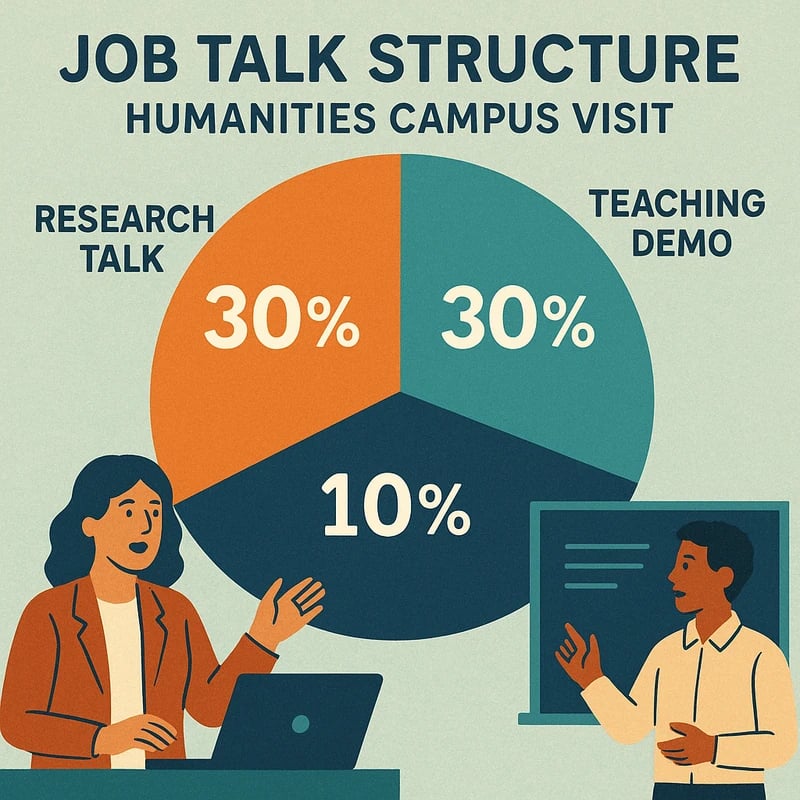
Discover the dual-track job talk structure—30/30/10 for research plus a live teaching demo—to signal depth, teaching readiness, and R2→R1 fit in higher ed.
Quick Answer
For humanities candidates moving from R2 toward R1, the campus-visit “job talk” should pair a 30/30/10 structure for the research presentation with a separate, real-class teaching demo. Plan a 70-minute session (about 30 minutes of a thesis-first research talk, 30 minutes of audience discussion, and 10 minutes framing fit to the department). Use a 12–14 slide deck and a 20–25 minute teaching demo built around a clear learning objective, an active task, and check-for-understanding. This dual-track blueprint makes both your depth and your teaching chops legible to a committee aiming for R1 status.
Key takeaway: A designed duo—job talk structure that centers an outcome-first thesis, plus a real-class teaching demo with a student-centered arc—offers the clearest signal of fit for an R2→R1 humanities hire.
Complete Guide to job talk structure in humanities campus visits
This guide lays out a dual-track plan tailored to R2→R1 contexts: a 30/30/10 job talk structure for the research talk, plus a “real-class” teaching demo blueprint that feels like a live class. The aim is to let depth coexist with breadth, and to connect scholarly ambition to classroom impact and department goals. You’ll find timeboxed scripts, slide guidance, and practical prompts you can adapt to your own work.
-
Time and slide strategy
-
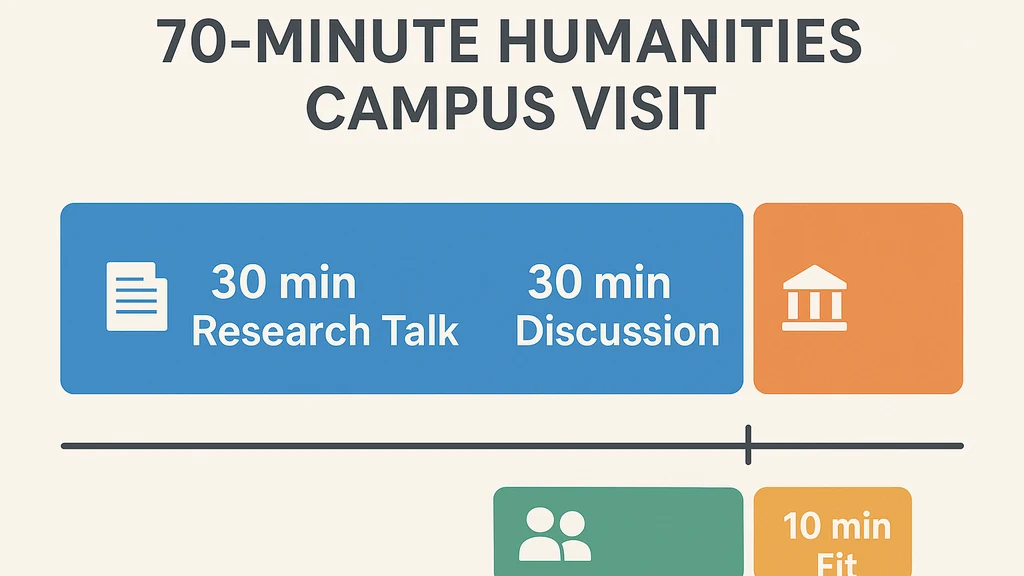
The recommended total visit window: 70 minutes split into three parts: 30 minutes for the research talk (outcome-first thesis and evidence arc), 30 minutes for discussion/Q&A, and 10 minutes dedicated to demonstrating fit through department-aligned messaging. This 30/30/10 job talk framework is a reliable way to balance the research narrative with collegial and curricular signals.
-
Slide count and pacing: plan 12–14 slides for the research talk, roughly one slide per minute, with a few transition slides to signal the move from thesis to evidence to implication. This keeps the structure visible and helps committee members follow the logic without getting lost in data dumps.
-
Teaching demo length: 20–25 minutes of active instruction, followed by 5–10 minutes of debrief and transition to the Q&A. The teaching segment should feel like a mini-class—interactive, student-centered, and clearly connected to course objectives.
-
-
The research talk: outcome-first thesis, evidence arc, department fit
- Outcome-first thesis: open with a tightly stated question or problem, then connect it to a clear, testable outcome for the field. This foregrounds impact, which is crucial when a committee weighs whether to push toward R1 status.
- Evidence arc: structure the middle around a cohesive arc of evidence—primary sources, methods, and contextualization—pulled together to demonstrate a scalable research program. Emphasize how your sequence of investigations builds the next steps, rather than presenting isolated projects.
- Pipeline and fit to department: close the talk with a concrete outline of future work, potential collaborations, and course or seminar topics you could contribute. Make explicit how your research trajectory aligns with the department’s strengths, flagship programs, and teaching needs.
-
The teaching demo: make it a real class, not a conference talk
- Learning objective first: state a specific, measurable learning goal for the 20–25-minute demo. This makes the exercise comparable to a real classroom and invites the audience to assess whether students would actually achieve something meaningful.
- Active task: design an activity that requires participation, collaboration, or critical thinking—such as a brief think-pair-share, a quick small-group analysis of a primary source, or a mini-prompt for close-reading. Timebox the activity to 8–12 minutes, then rotate to a quick share-out.
- Check-for-understanding: insert a 2–3 minute formative check (poll, show of hands, a brief write-after-task) to gauge whether the class is absorbing key ideas. This demonstrates your ability to read a room and adjust on the fly.
- Wrap and connect: end with a short connection to broader course goals, followed by a bridge to discussion and questions. Clarify how the activity connects with the course’s aims and the student learning experience.
-
Research talk scripts and slide templates (example prompts)
- Slide 1 (Opening): “I’m studying X because of Y, and I aim to demonstrate Z.”
- Slide 6 (Evidence): “What does this source reveal about A? What does it not tell us? How might B illuminate this gap?”
- Slide 11 (Future work): “Over the next five years, I plan to pursue C and seek collaborations with D and E.”
- Teaching demo prompt (objective): “Learning objective: students will analyze a primary source to identify authorial bias while articulating its historical context.”
- Teaching activity prompt: “Think-pair-share: what is one interpretive question the text raises? Share with a partner, then with the full class.”
-
Checkpoints and adjustments during the visit
- Have a few “adjustment scripts” ready: if the room is quiet, invite questions with a targeted prompt; if time runs short, summarize the key takeaways with a focus on impact. The ability to adapt under pressure signals strong professional judgment.
- Practice with a mock audience that mirrors a real campus visit (faculty, graduate students, and a few undergraduates if possible). Record and review the practice session for pacing, clarity, and engagement.
-
Demonstrating fit to a department: signals that resonate
- Courses you can offer: articulate at least two new or strengthening course ideas tied to department offerings.
- Mentorship and student pipelines: describe your mentoring approach and how you intend to supervise MA/PhD students, internships, or undergraduate researchers.
- Cross-disciplinary potential: outline possible collaborations or seminars that bridge your specialty with adjacent fields in the department.
- Service and community: mention plans for service to the department and the broader campus community, including outreach or public-facing scholarship.
-
Practical, immediate takeaways for prep
- Build a 70-minute plan with a written, public-facing outline you can share in the department dossier.
- Create a teaching demo packet that includes the learning objective, activity prompts, a one-page handout for students, and a short wrap-up that connects to core course goals.
- Develop 2–3 short, direct responses to typical questions about your research program, teaching philosophy, and future plans.
- Practice with a timer, and rehearse in a space similar to the actual venue when possible.
-
Related topics to explore (internal linking ideas)
- research talk structure humanities
- teaching demo campus visit humanities
- R2 to R1 faculty interview presentation
- how to make teaching demos interactive
- humanities job talk outline
- campus visit best practices for humanities
-
Key takeaways from this section
- The 30/30/10 job talk framework clarifies time, emphasis, and department alignment.
- The real-class teaching demo should foreground learning objectives, active tasks, and student understanding.
- Clear signals of fit—courses you can offer, mentorship plans, cross-disciplinary potential—are as important as your research narrative.
-
2-3 statistics, data points, or expert-informed observations
- Time on task matters: a 70-minute slot (30/30/10) is a common allocation for humanities campus visits aiming at R1 ambitions.
- Depth plus classroom readiness: research talks that explicitly discuss future projects and garden-paths for departmental collaborations tend to rate higher on “fit.”
- Teaching demos drive perception of readiness: candidates who show a clearly scaffolded, student-centered activity with a defined objective are more likely to be viewed as ready to teach at the undergraduate level.
-
Key takeaway
- Treat the campus visit as a two-track evaluation: a rigorous, outcome-driven research talk and a genuine, student-centered teaching demonstration. When you map both tracks to the department’s needs, you build a compelling, cohesive case for moving from R2 to R1.
Why This Matters
In today’s humanities hiring landscape, many committees at R1 institutions seek evidence that a candidate can contribute robustly to research while also strengthening teaching and program development. The dual-track approach is born from this reality: it foregrounds depth and trajectory in research while proving the practical classroom impact and curricular leadership you can bring to the department. The last few months have seen renewed emphasis on transparent learning outcomes, accessible scholarly communication, and demonstrable student engagement in teaching demonstrations. This convergence matters for humanities candidates because it translates abstract scholarly potential into concrete, observable classroom and programmatic contributions.
-
Trends and context
- A growing number of humanities job talks now foreground learning outcomes and teaching versatility as part of the evaluation, not as a separate add-on.
- Departments increasingly look for evidence of public-facing scholarship and community engagement that aligns with teaching missions, particularly in R2 that are aspiring to R1 status.
- The best practice is to present a coherent research program alongside a compelling teaching plan, showing you can sustain a research project while fostering student growth and curiosity.
-
How to leverage this trend in prep
- Build your talk and teaching demo around a single narrative arc: why the work matters, what it will look like when you grow it, and how students participate in that growth.
- Strive for accessibility in your research talk—clear signposting, minimal jargon, and explicit implications for undergraduate learning when relevant.
- Prepare a ready-to-hand teaching activity that can be dropped into a standard undergraduate course, with a brief justification of pedagogy and measurable outcomes.
-
Key takeaways from Why This Matters
- A well-structured, dual-track visit communicates both scholarly ambition and teaching readiness, which is increasingly essential for R2→R1 moves.
- Clear signaling about future plans, departmental fit, and student impact often weighs as heavily as the immediate research results.
- Thoughtful teaching demos that mirror real classroom dynamics can distinguish a candidate in a crowded field.
People Also Ask
The following questions reflect common searches from humanities PhD candidates preparing campus visits. Each short answer below is designed to be actionable and directly tied to the 30/30/10 job talk framework and the teaching demo blueprint.
What makes an effective humanities job talk?
An effective humanities job talk presents an outcome-first thesis, a coherent evidence arc, and a clear plan for future work. It should connect to department strengths and demonstrate how your research scales from a scholarly article to ongoing projects with student involvement. Keep slides visually clean, avoid data dumps, and narrate a path from question to impact.
- Short answer takeaway: Lead with the claim, follow with evidence, and end with a tangible research trajectory that aligns with the department’s goals.
How should a research talk be structured for an R2 to R1 campus?
Structure the talk around a strong central question, a measurable argument, and a pathway to future projects. Use a 30-minute core narrative, supported by 2–3 case studies or source analyses, and finish with a 5–10 minute discussion about future directions and department fit.
- Short answer takeaway: Build depth with a tight argument and a scalable research program that invites collaboration and equity in student mentoring.
How can I design a teaching demo that feels like a real class?
Start with a clear learning objective, run a short active task, include a quick check-for-understanding, and wrap with a connection to course goals. Make it student-centered and interactive, not lecture-driven. Provide a one-page handout or prompt set so students know what to do and why.
- Short answer takeaway: Demonstrate genuine pedagogical intent with observable student engagement and measurable outcomes.
How long should a humanities job talk last?
Many humanities campus visits allocate about 70 minutes in a 30/30/10 format: roughly 30 minutes for the talk, 30 minutes for Q&A/discussion, and 10 minutes to address fit and department alignment.
- Short answer takeaway: Plan around a 70-minute window to balance rigorous scholarly presentation with conversation and fit signals.
How do you demonstrate fit to a department in a job talk?
Show specific plans for future research, potential courses you could teach, and mentorship approaches for graduate and undergraduate students. Highlight collaborations with existing faculty, overlaps with departmental priorities, and opportunities for grant or public-facing work.
- Short answer takeaway: Translate your research trajectory into concrete curricular and service contributions that align with the department’s needs.
What are good prompts for an interactive teaching demo?
Prompts should invite critical thinking and allow for discussion: analyze a primary source for bias or context; compare two readings on a shared theme; or apply a methodological lens (e.g., close reading, archival reasoning) to a short text. Include a quick share-out or reflection to close.
- Short answer takeaway: Use prompts that reveal your pedagogical aims, student engagement, and ability to scaffold complex ideas.
How to structure humanities teaching demo prompts for maximum impact?
Begin with a learning objective, then present a task that requires students to engage with primary materials, contextualize the material historically, and articulate their interpretation. Build in time for peer discussion and a concise instructor reflection that ties the activity to broader course goals.
- Short answer takeaway: A tight objective, active task, and reflection anchor the demo in real classroom dynamics.
How to balance depth vs breadth in the research talk?
Prioritize depth in one or two core questions while outlining a clear plan for broader projects. Use examples that illustrate scale and potential collaborations, and reserve the broader program discussion for the future work slide or Q&A to avoid overwhelming the audience with too many threads.
- Short answer takeaway: Depth with a coherent expansion plan beats a long, disjointed spread of topics.
How do you show teaching philosophy in the demo?
Demonstrate a student-centered approach, explicit engagement with learning objectives, and evidence of assessment strategies. Make clear how you adapt to different levels (majors, non-majors) and how you design inclusive activities that support diverse learners.
- Short answer takeaway: Tie teaching philosophy to observable practice through objective-driven activities and reflective assessment.
How to craft slides for a humanities job talk?
Keep slides text-light, with a clear through-line: thesis, evidence, implication, and future work. Use a consistent design, readable fonts, and a few key visuals or primary-source images to anchor arguments. Practice transitions between slides to maintain a smooth narrative.
- Short answer takeaway: Visual clarity and narrative coherence trump data density in humanities talks.
Next Steps
If you’re in the trenches of prep, here are practical next steps to turn this blueprint into a polished campus-visit plan:
-
Draft your 70-minute script: outline the 30-minute research talk, 30-minute Q&A, and 10-minute department-fit wrap. Include your 12–14 slides and a one-page handout for the teaching demo.
-
Build a teaching-demo module: write a concrete learning objective, design an active task, prepare a brief check-for-understanding mechanism, and craft a closing bridge to course goals.
-
Prepare departmental-fit artifacts: two course proposals, a short mentorship plan, and a note on potential collaborators within the department.
-
Practice with a real audience: simulate the committee and students; time the session, gather feedback, and refine transitions, prompts, and wrap-up statements.
-
Create a cheat sheet for quick responses: 6–8 concise answers to common questions about your research trajectory, teaching philosophy, and future plans.
-
Key takeaway
- A deliberate, well-practiced set of scripts and activities—paired with thoughtful signals of fit—is the most reliable path to a successful humanities campus visit at an R2 institution moving toward R1 status.
If you’re reading this during the second cup of coffee before a campus visit, remember: you’re not just presenting a project; you’re inviting the committee into your ongoing scholarly journey and your classroom practice. The 30/30/10 job talk structure and the real-class teaching demo are tools to reveal both your intellectual production and your capacity to cultivate clear learning experiences for students. With intentional preparation, your dual-track plan becomes not a tricky juggling act but a coherent narrative of scholarly ambition aligned with teaching leadership.
Key takeaways
- The 30/30/10 job talk framework provides a transparent, department-facing structure that foregrounds depth, engagement, and fit.
- A real-class teaching demo demonstrates immediate classroom readiness and student-centered pedagogy, not just content expertise.
- The combination signals to R1-ready departments that you can contribute to research growth, program development, and undergraduate education—an especially compelling package for a humanities candidate on an R2→R1 trajectory.