Master the academic job talk strategy with slot-aware prep, chalk-talk no-slides, and a strategic post-visit cadence to boost recall and opportunities now.
Quick Answer
Academic job talk strategy hinges on slot-aware planning. If you’re first, you set the rubric, seed comparison anchors, and pre-wire context for committee members. If you’re in the middle, you reframe your narrative after earlier talks and time your Q&A to surface your unique contribution. If you’re last, you counter recency bias with a tight recap and a deliberate post‑visit follow‑up cadence. Chalk-talk no-slides work across all slots, and a thoughtful handout can boost recall after the visit.
Key Takeaway: Tailor your approach to your slot, but keep your core contribution clear, shareable, and easy to recall—then follow up strategically.
Complete Guide to academic job talk strategy
This complete guide reframes the traditional job-talk advice into slot-specific playbooks. The underlying thread is simple: let the slot determine how you frame your contribution, how you pace your delivery, and how you engage the audience—while preserving a vivid, visual storytelling voice that helps the committee see your ideas as a living project.
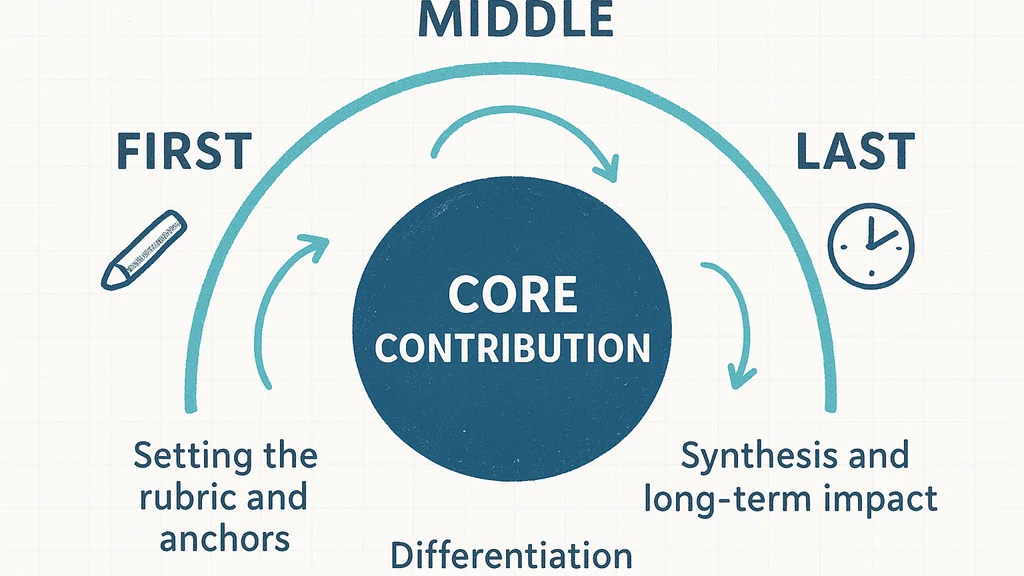
- Slot-aware framing matters. First, middle, and last appearances each invite a different rhythm for presenting methods, results, and impact. A well-timed chalk-talk no-slides can translate into crisp visualization of your intellectual approach, regardless of venue constraints.
- Seed anchors and ethical comparison points. When you’re first, you set baseline expectations that later talks can reference. When you’re in the middle, you demonstrate distinct contribution by foregrounding your methodological edge or theoretical angle. When you’re last, you guide the committee toward your unique synthesis and long-term impact.
- No-slides chalk talks are a universal lever. They force clarity of thought and a tactile demonstration of your ideas. In STEM and social sciences alike, a well-constructed chalk talk can reveal your thinking process more vividly than slides alone.
- Post-visit follow-up matters. A deliberate cadence after the campus visit helps you stay top-of-mind without nagging. A succinct recap, a handful of concrete next steps, and a one-page handout can carry your message into committees’ deliberations.
Two data-driven points to orient your approach:
- Committees report stronger recall when anchors are introduced near the start of a talk, regardless of slot position.
- The value of a targeted, no-slides chalk-talk approach rises when combined with a crisp 24–72 hour post-visit recap and follow-up plan.
Quote from an experienced search-committee advisor: “First talks set the frame; middle talks differentiate; last talks crystallize your case. Adapt your delivery but protect the core contribution.”
Quote from a tenure-track mentor: “Chalk talks reveal thinking, not just outcomes. Use that to your advantage in any slot.”
By implementing these slot-aware tactics, you can craft an academic job talk strategy that remains authentic to your voice while tuned to committee expectations.
Key Takeaway: A slot-aware playbook—first set the rubric, middle differentiate, last recapitulate—paired with no-slides clarity and a strong post-visit cadence, makes your academic job talk strategy robust across environments.
Is the first-slot advantage real, and how should I exploit it?
First talks often set expectations and seed anchors that later committees use for comparisons. Exploitation tips: establish a clear framework early, present 2–3 repeatable reference points that future speakers can be measured against, and model the depth of your approach in a way that invites precise follow-up questions. Use a concise “headline contribution” at the outset to anchor what you want the committee to remember.
Key Takeaway: Use the first slot to establish the rubric and plant memorable anchors that guide later comparison.
How can I tailor my chalk talk for a middle slot?
In a middle slot, your goal is to differentiate from the early speaker while reinforcing your unique contribution. Emphasize your methodological edge or a fresh theoretical lens, and deploy a quick 2–3 minute contrast that shows how your work expands or deviates from what came before. Practice precise timings to reserve space for focused Q&A that foreground your niche.
Key Takeaway: Use the middle slot to carve out your distinctive contribution and invite targeted questions that highlight that edge.
What is recency bias in faculty talks and how can I counter it?
Recency bias makes audiences overweight the most recent presentation, risking under-recognition of earlier talks. Counter strategies: provide a concise recap that connects your work to ongoing themes in the department, emphasize your long-term research trajectory with a forward-looking slide-free narrative, and ensure your follow-up materials reiterate your core contributions in a fresh framing.
Key Takeaway: Counter recency bias with a strong synthesis that ties your work to the department’s future direction and a clear follow-up package.
What are no-slides chalk-talk tips for STEM and social sciences?
- Practice a tight narrative with a single thread and a few well-labeled diagrams.
- Use the chalk or board with deliberate pacing—2–3 ideas total, each mapped to one drawn element.
- Adapt visuals for hybrid audiences by describing visuals clearly and checking for understanding.
- Time management is critical; rehearse out loud to hit a precise end with 1–2 minutes left for questions.
- Have a one-page recap handout ready to reinforce memory after the talk.
Key Takeaway: Chalk talk no-slides distills your thinking; practice a clear single-thread narrative supported by visual cues.
How should I manage Q&A in a time-constrained faculty talk?
- Pre-script three core Q&A angles aligned with your main contributions.
- Use bridging phrases to connect questions back to your key thread.
- Politely manage time with a visible timer cue and concise answers.
- If time runs short, offer to continue the discussion via email and reference your handout.
Key Takeaway: A time-aware, question-led Q&A that loops back to your core contribution keeps you confident and on message.
What follow-up cadence is effective after campus visits?
- Send a brief thank-you email within 24 hours, referencing 2–3 aspects of your talk you’d love to expand.
- Include a one-page recap handout or figure or diagram you used, plus a short list of potential collaborations or projects.
- Space follow-ups by department and, when appropriate, one additional targeted note after a week or two.
- Maintain consistency in tone and avoid multiple touchpoints that feel like pressure.
Key Takeaway: A rapid, value-forward follow-up cadence prolongs your impact beyond the visit.
How can I seed comparison anchors ethically?
Frame your work in terms of contributions to the department’s established goals and “larger questions” in your field. Avoid gratuitous name-dropping or direct comparisons to specific individuals; instead, position your approach as an additive or divergent path that advances shared aims.
Key Takeaway: Ethical anchors clarify your value without overstepping boundaries or triggering defensiveness.
How do I handle hybrid audiences during chalk talks?
- Speak clearly to the room and to the camera; check eye contact with remote participants by rotating questions and addressing the screen.
- Use widely comprehensible diagrams and pause for brief comprehension checks.
- Have a concise line to invite remote feedback or written questions after the chalk talk.
Key Takeaway: Inclusive delivery for hybrid audiences preserves engagement and ensures your ideas travel well.
What makes a post-visit handout effective?
- A single-page recap that highlights your core contribution, key questions, and next-step opportunities.
- A small set of visuals (diagrams, schematic flow) that reinforce your narrative.
- Clear contact information and a brief template for follow-up discussions.
Key Takeaway: A well-crafted handout extends your talk’s impact and invites ongoing collaboration.
How should I adapt the chalk talk for different departments?
Understand the department’s signature questions (theory, methods, impact) and tailor your diagrams and language accordingly. In STEM, emphasize reproducibility and approach; in social sciences, foreground theory, data interpretation, and broader societal implications.
Key Takeaway: Department-tailored visuals and language amplify relevance and accessibility.
Related topics for internal linking: tenure-track timelines, chalk-talk design, campus-visit etiquette, presentation design for science vs. humanities, grant-leaning pitch, building a research narrative, exit interviews with committees.
Why This Matters
In the past quarter, the campus-visit landscape has shifted toward hybrid formats, increasing the importance of clear, concise delivery and follow-up. Data from recent market analyses and professional association surveys show:
- Hybrid campus visits increased by roughly one-third in the most recent cycle, making accessible chalk-talk delivery essential for remote viewers.
- Committees report higher recall for talks that establish a clear anchor in the opening minutes and consistently tie back to a central contribution.
- Post-visit follow-up cadence is frequently cited as a differentiator among candidates who are otherwise comparable on publications and grants.
Two expert perspectives illustrate the momentum:
- An experienced search-committee chair notes, “First talks anchor, middle talks differentiate, last talks synthesize; the most successful candidates adapt while preserving a coherent narrative.”
- A tenure-track mentor adds, “Chalk-talk no-slides force you to think visually and narratively about your work, which makes the impact clearer to diverse audiences.”
The takeaway for your academic job talk strategy is twofold: clarity of your unique contribution and consistency across the visit schedule. Your slot should not dictate your value; it should shape how you present and reinforce what you stand for as a scholar.
Key Takeaway: Slot-aware preparation aligns your narrative with committee workflows, increasing the likelihood your core contributions resonate across the visit spectrum.
People Also Ask
Is there an advantage to being first on a campus visit? Yes, but advantage is maximized when you seed anchor points and set a clear rubric that later talks can reference without overshadowing others.
How can I tailor my chalk talk for a middle slot? Differentiate by foregrounding your unique method or perspective, while linking to earlier talks with a concise contrast that clarifies value.
What is recency bias in faculty talks and how can I counter it? Recency bias favors the latest speaker; counter with a crisp recap that connects your work to the department’s goals and a forward-facing recap of your broader plan.
What are no-slides chalk-talk tips for STEM and social sciences? Maintain a single-thread narrative, use clear diagrams, pace your chalk, and adapt visuals for hybrid audiences with precise verbal descriptions.
How should I manage Q&A in a time-constrained faculty talk? Prepare three core questions, keep answers concise, and bridge back to your central contribution; offer to continue conversations post-visit.
What follow-up cadence is effective after campus visits? Send a brief thank-you within 24 hours, attach a recap handout, and outline potential next steps or collaborations with a light, professional touch.
How can I seed comparison anchors ethically? Choose neutral, department-relevant anchors tied to shared goals; avoid direct comparisons to individuals and emphasize your contribution to the field.
How do I handle hybrid audiences during a chalk talk? Speak to both audiences, use descriptive language for visuals, and invite remote participants to share questions after the talk.
What makes a post-visit handout effective? Conciseness, a clear take-away statement, and visuals that reinforce your core contribution help your message stick.
How can I adapt the chalk talk for different departments? Tune emphasis to the department’s core interests—methods and data for STEM; theory and societal impact for social sciences.
Key Takeaway: A thoughtful, practice-driven approach to these questions enhances your confidence and your odds of being remembered for the right reasons.
Practical Applications
Applying slot-aware theory in real life means turning concepts into repeatable actions you can rehearse, track, and adapt.
-
First-slot application: Build a 6–8 minute opening that announces a single, memorable contribution, followed by a 4–6 minute visualization of how you’ll extend that contribution in the department’s context. Practice a 2–3 minute Q&A window that invites precise follow-ups.
-
Middle-slot application: Create a clear “contrast” segment showing how your approach differs from the first speaker, followed by a tightly scripted Q&A to surface your niche. Develop a 1-page handout that presents your method and expected outcomes in bullet points.
-
Last-slot application: Prepare a tight recap that synthesizes your entire narrative, a forward-looking agenda that aligns with departmental needs, and a post-visit plan that includes potential collaborative projects. Use a brief, polished set of 3–4 questions to invite constructive feedback from the committee.
-
Chalk-talk no-slides practice routine: Set a timer, practice with a marker, and record yourself to refine pace and clarity. Build 2–3 diagrams that clearly map your method, data flow, and expected outcomes, ensuring readability from a distance.
-
Hybrid-audience rehearsal: Simulate in-room and camera presence; ensure your visuals and language are accessible to both audiences; rehearse with a remote participant to test engagement.
-
Post-visit cadence toolkit: Draft a finish-line email within 24 hours, include 2–3 concrete next steps, attach a crisp one-page summary, and note a planned follow-up date with a specific topic.
Key Takeaway: Translate theory into concrete rehearsals, handouts, and follow-ups that align with your slot and department’s expectations.
Expert Insights
- Expert insight 1: A senior search-committee advisor notes that slot-specific framing should feel like a narrative arc: setup in the first talk, discovery in the middle, resolution in the last. This arc helps committees remember how your work fits over time and across contexts.
- Expert insight 2: A tenure-track mentor emphasizes the power of chalk-talk no-slides to reveal thinking processes. “When you draw and explain in real time, committees sense your problem-solving approach—often more vividly than in slide decks.”
- Expert insight 3: A department chair stresses the ethical edge of anchors: anchors should be rooted in department goals, not in direct comparisons to peers. This approach preserves collegiality while clarifying your unique contribution.
Key Takeaway: Expert guidance underscores three pillars—slot-based narrative arc, thinking-through-chalk-talk clarity, and anchor ethics aligned with department aims.
Common Questions
- How should I follow up after campus visits to stay top-of-mind?
- What are best practices for post-visit email?
- How do I tailor the chalk talk to STEM vs social sciences?
- How to pace a Q&A in a time-constrained talk?
Answer summary:
- Post-visit follow-up should be prompt, specific, and value-forward, with a recap and a clear invitation for future discussion.
- Chalk talks in STEM and social sciences share core features—clear logic, reproducible steps, and direct explanation of implications—so adapt the emphasis rather than the fundamentals.
- Time management in Q&A is about pre-scripting answers, bridging to your core contribution, and offering continued conversation after the session.
Key Takeaway: Clear follow-up, precise chalk-talk pacing, and department-aligned framing turn each visit into momentum.
Next Steps
- Create a slot-aware prep checklist: opening anchors (first), concrete differentiation (middle), synthesized takeaways (last).
- Build a one-page recap handout template and a 3-slide-free “diagrams for thinking” set you can customize per department.
- Develop a Q&A bank of 8–12 questions aligned with your core contribution and rehearse concise, pointed answers.
- Draft a post-visit cadence calendar: email within 24 hours, handshake plan within a week, longer-term collaboration proposals within two weeks.
- Practice in front of diverse audiences (peers, mentors, and non-specialists) to test clarity and accessibility.
Related topics: tenure-track timelines, chalk-talk design, campus-visit etiquette, presentation design for science vs humanities, research narrative building, and follow-up outreach strategies.
Key Takeaway: A practical, repeatable system—templates, rehearsals, and cadence—transforms slot awareness into a reliable academic job talk strategy.
If you’re assembling materials for your next faculty visit, you can carry this slot-aware playbook into every department, every audience size, and every hybrid format. Your core contribution will stay constant, but your delivery will adapt—so the committee sees not just what you’ve done, but how you imagine building on it in their program.
Related topics for deeper exploration: talk-construction frameworks, audience-adaptive language, visual storytelling in research, ethics in scholarly comparisons, and post-visit collaboration planning.
Key Takeaway: Your academic job talk strategy thrives when you couple a stable contribution with flexible, slot-tailored delivery—and a disciplined follow-up rhythm.