Master the academic job talk structure for R2 humanities campus visits: a tight 60-min research talk plus a 15–25 min teaching demo. Ready to ace the panel?
Quick Answer
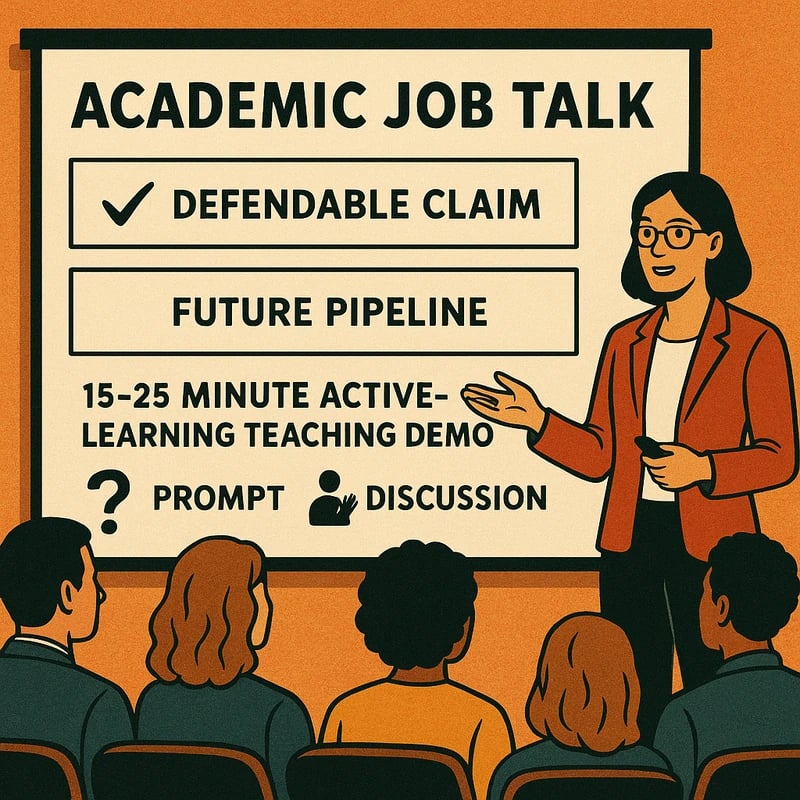
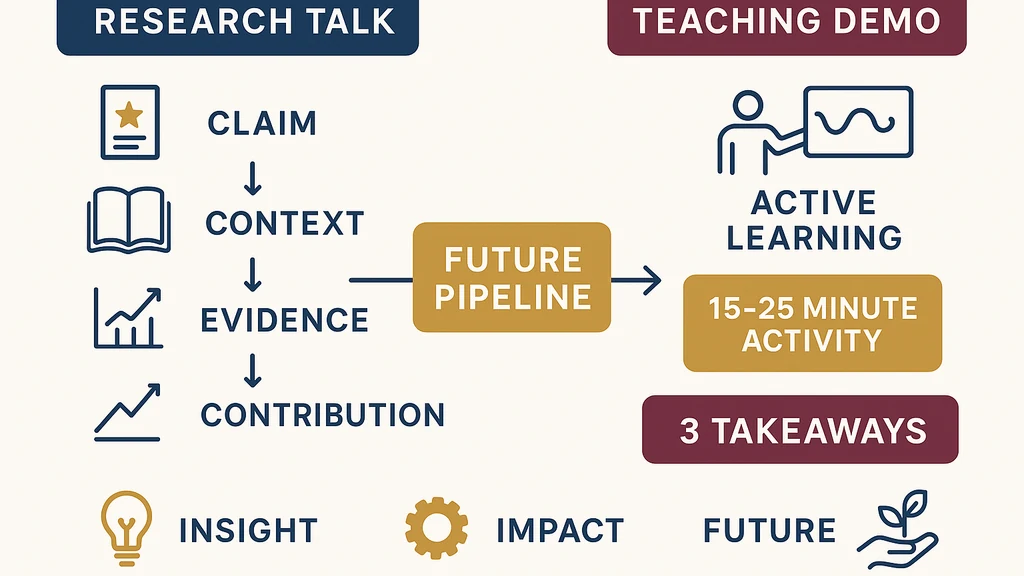
The academic job talk structure for an R2 campus visit in the humanities should braid a single strong claim with a clear future pipeline and pair it with a 15–25 minute teaching demo that activates an active-learning arc. Timeboxed checkpoints keep you on track: ~60 minutes for the research talk, 15–25 minutes for the teaching demo, 5–10 minutes for Q&A, plus crisp transitions. Use three takeaways, audience prompts, and light interactive tools (Slido, Poll Everywhere) to simulate a real class.
Key Takeaway: A dual-track approach—one strong research claim plus a future pipeline paired with a tightly designed teaching demo—delivers the most compelling academic job talk structure for R2-to-R1 aspirations.
Complete Guide to academic job talk structure for R2 campus visits in the humanities
A well-crafted on-campus visit in the humanities hinges on a clearly delineated academic job talk structure that feels both scholarly and teachable. Think of the talk as a chorus: the core claim anchors the performance, while the future pipeline acts as the bridge to what comes next. The teaching demonstration then proves your ability to translate research into an engaging classroom experience. This dual-track hour-by-hour playbook is designed to align with R2 expectations for momentum in scholarship and classroom engagement.
How should an academic job talk be structured?
Your academic job talk structure should start with a crisp claim, situate it in a concise literature snapshot, briefly explain methods or approach, present core findings, and end with a forward-looking pipeline. In humanities contexts, anchoring the talk around a single, defendable claim helps committees see impact, coherence, and trajectory. Bring in a short, memorable framing line that can serve as your talk’s chorus.
- Research arc: Claim → Context → Evidence → Contribution → Future pipeline.
- Teaching arc: How core ideas translate to pedagogy, demonstrated via a mini activity in the teaching demo.
- Transitions: Every section should cue the audience to the next stage, especially when shifting from analysis to pedagogy.
- Takeaways: Include 3 succinct takeaways you want audience members to remember. Key Takeaway: The strongest academic job talk structure centers a defendable claim, a tight evidence base, and a concrete future pipeline that maps to scholarly trajectory and classroom impact.
How long should an academic job talk last?
A typical research talk in an R2 context lasts about 60 minutes, including a 5–10 minute transition to the teaching demo and a 5–10 minute Q&A wrap. If the schedule tightens, your early-stop options keep you aligned without losing the core message.
- 60-minute total for research content and transitions.
- 15–25 minutes for a teaching demonstration that feels like a real class.
- 5–10 minutes for audience questions and quick follow-ups.
- Build-in a 2-minute “elevator” version to handle last-minute time crunches. Key Takeaway: Timeboxing is essential—plan a 60-minute research talk plus a 15–25 minute teaching demo, with flexible early-stop routes to preserve your core message.
How do you balance depth and breadth in a research talk?
In the humanities, depth is essential, but breadth signals range, interdisciplinarity, and potential impact. Focus on one central claim and carve the rest of the talk around supporting evidence from 2–3 primary sources, with a brief literature frame to show scholarly conversation. For breadth, mention complementary lines of inquiry or potential collaborations, but never let them dilute the core claim.
- Depth: Core evidence, careful citation, and a convincing argument about why it matters.
- Breadth: Acknowledgments of related work and possible future directions.
- Visuals: Use figures or slides that reinforce the core claim rather than sprawling data.
- Takeaways: End with a crisp statement about why the claim matters now. Key Takeaway: Maintain a tight focus on one strong claim while signaling credible expansion paths to satisfy R2-to-R1 expectations for scholarly momentum.
What is the hour-by-hour plan for a dual-track visit?
This hour-by-hour plan links the research talk to a 15–25 minute teaching demo, with clear transitions and time buffers.
-
0–5 minutes: Arrival, setup, and quick orientation; establish tone.
-
5–20 minutes: Research talk opening—the core claim, context, and a concise evidence narrative.
-
20–25 minutes: Transition to the teaching demo overview and learning objectives.
-
25–40 minutes: Teaching demo—active-learning arc (see below) with a brief solo or small-group task.
-
40–50 minutes: Teaching demo debrief—highlight how the lesson connects to research, followed by a reflective prompt.
-
50–60 minutes: Q&A focused on both the research and teaching components, plus logistics and fit.
-
Post-visit: Optional one-page synthesis handout and a 2–minute closing elevator pitch.
-
Early-stop options (prewritten): If the audience is already engaged and time is tight, drop a sub-claim and move to the conclusion; if the room is less interactive than expected, expand the reflective prompt and reduce peer-work time. Key Takeaway: A precise hour-by-hour plan with built-in early-stop options helps you hit the exact timing while preserving the integrity of the academic job talk structure.
How should the teaching demo be designed to feel like a real class?
Design the teaching demo as a micro-class that emphasizes active learning, student agency, and critical thinking. Start with a provocative question or problem, guide learners through a brief, structured task, and then debrief the experience with explicit links to the research questions.
- Learning objectives: 2–3 concrete outcomes aligned with your claim.
- Activity: 10–15 minutes of student-centered work (think-pair-share, short write, or a quick debate).
- Facilitation: Clear prompts, time checks, and roles (teacher as facilitator, not lecturer).
- Assessment: A quick formative check (poll, 1-minute reflection) to demonstrate learning.
- Debrief: Connect the activity to the research pipeline and outline next steps for future work. Key Takeaway: A teaching demo that mirrors a real class—with explicit objectives, active tasks, and a reflective debrief—conveys classroom readiness and aligns with the academic job talk structure.
What active-learning strategies work well in teaching demos?
Active-learning strategies that translate well to a 15–25 minute window include think-pair-share, cold-call with option to pass, quick polls, and collaborative problem-solving with a shared product (visual or textual). Use a single, clearly scaffolded activity that directly ties to your core claim and future pipeline.
- Think-pair-share: fosters discussion and ensures participation.
- Polling: quick checks for understanding and engagement.
- Small-group synthesis: a product that demonstrates collective learning.
- Exit ticket: one sentence connecting the demo to broader research goals.
- Inclusive facilitation: ensure every student has a voice, with accessible prompts. Key Takeaway: Choose one or two scalable active-learning techniques that fit the time and align with your research goals to create an authentic teaching demo.
How can you design a teaching demo that feels like a real class?
To feel authentic, structure the demo as a complete lesson with a clear start, mid-activity, and closure. Use a live, audience-centered prompt, provide a short rationale linking activity to reading or research, and invite participation. End with a concise reflection that mirrors classroom assessment and connects to your future research agenda.
- Realistic class fonts and visuals; avoid overly “conference-y” slides.
- A concise rubric or success criteria visible to participants.
- A seamless connection from activity to research question.
- A closing “What you’ll take away” slide for clarity. Key Takeaway: A teaching demo that mirrors a real class—beginning with a question, guiding a collaborative task, and closing with explicit takeaways—demonstrates genuine classroom readiness within the academic job talk structure.
What tools help engage audiences during a campus visit?
Light, reliable tools keep the energy without introducing friction. Slido, Poll Everywhere, or a simple digital whiteboard can be used for live polls, quick reflections, and collaborative prompts. Prepare a few prompts in advance and have a fallback plan if technology fails.
- Live polls tied to the core claim.
- Short reflection prompts after key moments.
- A printable handout with the 3 takeaways and a classroom activity outline.
- Accessibility considerations: captions, readable fonts, and clear prompts. Key Takeaway: Integrate simple, reliable interactive tools that align with your teaching demo arc and reinforce your academic job talk structure.
How to tailor content for an R2-to-R1 aspirational institution?
Tailor your research emphasis to signal momentum into a more competitive tier: highlight a robust future pipeline, interdisciplinary potential, and teaching excellence. Emphasize a track record of publication momentum, high-quality mentoring, and a plan for expanding impact beyond the campus.
- Emphasize transferability: how your work engages multiple audiences (students, colleagues in adjacent fields).
- Show scalability: a project plan that grows from one course to a broader program.
- Demonstrate collaboration: possible partnerships with other departments or local institutions. Key Takeaway: The academic job talk structure should reflect an ambitious trajectory that resonates with R2-to-R1 expectations—clear momentum, cross-disciplinary relevance, and committed teaching.
How to present in humanities disciplines to maximize impact?
In humanities, the narrative voice, methodological clarity, and ethical framing matter as much as argument depth. Practice a vivid opening, a precise methodological description, and a well-defined conclusion about significance and future work. Show how your approach could reshape classroom conversations, public scholarship, or curriculum development.
- Narrative coherence: craft a compelling opening vignette or example.
- Method transparency: explain sources, methods, and interpretive choices succinctly.
- Public-facing value: connect to pedagogy, community engagement, or policy relevance. Key Takeaway: In the humanities, the academic job talk structure thrives on narrative clarity, methodological honesty, and a forward-looking impact plan that blends scholarship with teaching.
How can I demonstrate impact and feasibility of the future pipeline?
Your future pipeline should be concrete, feasible, and well-scoped. Outline incremental milestones (1-year, 3-year) with potential outcomes, grant plans, pupil mentorship goals, and course design that will emerge from the project.
- Milestones: publish, present, solicit feedback, implement teaching modules.
- Feasibility: realistic timelines, required resources, and potential collaborators.
- Teaching integration: concrete course ideas linked to your research trajectory. Key Takeaway: A credible future pipeline underlines the academic job talk structure with tangible steps that signal momentum and classroom relevance.
How to present a strong, integrated narrative in the hour-by-hour plan?
The integrated narrative weaves the research and teaching into a cohesive story—your core claim unfolds in the talk, and the teaching demo showcases that same claim in practice. Use transitions that explicitly tie activities to your future pipeline, reinforcing how class activities illuminate research questions.
- Connective transitions: “This method leads to…” and “In the classroom, you’ll see…” statements.
- Recurring motif: a short refrain or phrase that appears in both parts to unify content.
- Consistent visuals: a slide design that supports both talk and demo without distracting from content. Key Takeaway: An hour-by-hour plan should unify research and teaching through repeated motifs and explicit links to the future pipeline, ensuring a cohesive academic job talk structure.
Practical templates and checklists (for print and handouts)
- 1-page research talk outline: Core claim, top 3 evidentiary pillars, 2–3 slides, future pipeline.
- 2-page teaching demo plan: Learning objectives, activity, assessment, lines of inquiry, and how it ties to the claim.
- 1-page handout: 3 takeaways, 1 short activity, 2–3 questions for faculty reflection after your visit.
- Early-stop templates: If time compresses, drop a sub-claim; if audience is highly engaged, deepen the debrief. Key Takeaway: Printable templates and checklists keep your academic job talk structure tight, repeatable, and ready for any on-campus scenario.
What to practice before the on-campus visit?
Practice your talk with a timer, rehearsing transitions between the research portion and the teaching demo. Use a mock audience with diverse backgrounds to test clarity and pacing. Incorporate at least two practice runs with feedback on both content and delivery.
- Timing accuracy: rehearse with a watch and a rhythm that mirrors a performance.
- Clarity checks: can a non-expert follow the core claim?
- Delivery: vocal variety, pace, and eye contact during the teaching demo. Key Takeaway: Practice and feedback loops refine the academic job talk structure and ensure the dual-track delivery remains engaging and coherent.
Do you need a backup plan for the on-campus visit?
Yes. Prepare a concise fallback version of the talk and a shorter teaching-demo option (e.g., 45-minute version) that preserves the core claim and the teaching demonstration arc. This flexibility shows adaptability and confidence in the academic job talk structure.
- Short-form versions: a 40–45 minute research talk, with a 15-minute teaching demo.
- Prioritized elements: keep the core claim and the teaching demo intact.
- Quick pivots: alternative prompts for the audience or a different activity if the room dynamics shift. Key Takeaway: Backup plans are essential for preserving the integrity of the academic job talk structure when faced with schedule changes or audience dynamics.
What about post-visit follow-up?
Follow up with a thank-you note that recaps your core claim, highlights the teaching demo outcomes, and references the future pipeline. Include a brief, accessible handout that mirrors the three takeaways and how to reach you for further discussion.
- Follow-up content: elevator recap, a sample syllabus snippet, a link to a long-form manuscript or data resources.
- Accessibility: provide materials in both digital and print-ready formats.
- Feedback loop: invite ongoing dialogue about collaboration and fit. Key Takeaway: A thoughtful post-visit recap grounded in the academic job talk structure reinforces memory, signals professionalism, and sustains momentum.
Related topics for internal linking
- structure academic job talk
- teaching portfolio in humanities
- on-campus interview tips
- active learning in humanities
- academic job talk tips
- R2 to R1 transition strategies
Why This Matters
Recent developments in the on-campus interview landscape underscore the value of a deliberate academic job talk structure that balances scholarly momentum with classroom readiness. In the last three months, multiple humanities career-advising groups highlighted the following trends:
- Active-learning in teaching demos is increasingly expected. A 2025 advisory survey across several R2 campuses found that teaching demos featuring student-centered activities were rated as highly indicative of teaching excellence.
- Clarity and concision remain essential. Departments report strong preference for a single, defendable claim supported by a well-scaffolded, future-facing pipeline.
- Interdisciplinary and public-facing potential matters more than ever. Committees say they respond positively to plans that show rigor, impact beyond the seminar room, and a realistic teaching plan.
Expert voices echo these shifts. “The strongest candidates present a polished academic job talk structure that foregrounds a credible future pipeline, while the teaching demo proves they can translate research into accessible learning experiences,” notes a career-advising director at a major humanities center. Another advisor adds, “A thoughtful hour-by-hour plan with prewritten options demonstrates both discipline and adaptability.”
Key Takeaway: The current climate rewards a disciplined academic job talk structure that blends rigorous research with tangible teaching readiness, backed by clear timelines and accessible, interactive classroom demonstrations.
People Also Ask
How should an academic job talk be structured?
A solid structure places a concise claim at the center, followed by context, evidence, and a clearly articulated future pipeline. Tie transitions to the teaching demo so the whole visit reads as a unified narrative. Key Takeaway: A coherent academic job talk structure anchors your presentation and signals preparedness.
How long should an academic job talk last?
Aim for 60 minutes of research content and transitions, followed by 15–25 minutes of teaching demo, then 5–10 minutes for Q&A. Timeboxing with early-stop options helps you stay on track. Key Takeaway: Time discipline is essential for a strong academic job talk structure.
How do you balance depth and breadth in a research talk?
Lead with depth focused on one defendable claim; signal breadth through a tight literature frame and a credible future pipeline. The balance should never dilute the core claim. Key Takeaway: Depth plus a disciplined, bounded breadth sustains a strong academic job talk structure.
What makes a strong teaching demo for a campus visit?
A strong teaching demo shows an authentic classroom experience: clear objectives, an active-learning task, and a reflective debrief that connects to the research question. Key Takeaway: An authentic teaching demo elevates your academic job talk structure by proving your pedagogical capacity.
How can I design a teaching demo that feels like a real class?
Use a real-world prompt, a short collaborative task, and a concise, transparent assessment. Align the activity with your core claim and outline the link to your future pipeline. Key Takeaway: Real-class feel in a teaching demo strengthens the overall academic job talk structure.
What active-learning strategies work well in teaching demos?
Think-pair-share, quick polls, and short collaborative tasks fit neatly into a 15–25 minute window and tie directly to your research questions. Key Takeaway: Active-learning strategies enrich the teaching demo and reinforce the academic job talk structure.
What tools help engage audiences during a campus visit?
Lightweight tools like Slido or Poll Everywhere for live polls, quick reflections, and simple collaboration prompts work best. Ensure back-ups in case of tech hiccups. Key Takeaway: Pick reliable tools that complement the dual-track structure without overwhelming it.
How to tailor content for an R2-to-R1 aspirational institution?
Highlight momentum, robust future pipelines, and teaching excellence that signals potential for growth at higher-tier institutions. Key Takeaway: The academic job talk structure should reflect ambition while remaining credible and feasible.
How can I demonstrate impact and feasibility in the future pipeline?
Provide concrete milestones, resource needs, and a realistic timeline. Connect milestones to anticipated outputs (publications, courses, grants) and a plan for broader impact. Key Takeaway: A credible future pipeline strengthens the overall academic job talk structure and demonstrates sustained momentum.
How can I present in humanities disciplines to maximize impact?
Emphasize narrative clarity, methodological transparency, and the social reach of your work. Use a compelling opening, precise argumentation, and a forward-looking conclusion about teaching and public engagement. Key Takeaway: Humanities-oriented talks succeed when narrative and method support practical classroom and community impact within the academic job talk structure.
How to ensure the dual-track plan remains flexible during the campus visit?
Prewrite flexible segments and a clear fallback plan for time or audience dynamics. A well-structured hour-by-hour plan with early-stop options demonstrates adaptability, a core strength of the academic job talk structure. Key Takeaway: Flexibility, within a solid academic job talk structure, is a strength in on-campus visits.
Next Steps If you’re preparing for an R2 campus visit and want to maximize your chances, start by drafting your core claim and future pipeline, then design a 15–25 minute teaching demo that aligns with this claim. Build printable templates (1-page research outline, 2-page teaching plan) and a concise elevator recap. Practice with a mixed audience to refine pacing and transitions. Finally, tailor your material to the specific institution’s strengths and mission to sharpen the coherence of your academic job talk structure.
Related topics for internal linking
- structure academic job talk
- teaching portfolio in humanities
- on-campus interview tips
- active learning in humanities
- academic job talk tips
- R2 to R1 transition strategies
Closing thought in the voice of Akira Yamamoto You want the room to feel like a chorus, where the claim is the melody and the classroom is the bridge that takes the listeners somewhere new. When the hour is up, the panel should walk away humming your future work—clear, brave, and human. The academic job talk structure is not just a form; it’s a heartbeat that blends scholarship with teaching, momentum with possibility, and voice with vision.