Learn how a corporate development interview presentation uses a three-slide framework and a 90-second opener to win panels, with backup slides today.
Quick Overview
In a corporate development interview presentation, the clock rules. A crisp 15-minute cadence rests on a repeatable 3-slide framework plus a 90-second opener that compels the room to lean in. Structure your thoughts around a market screen and thesis, a fit plus deal logic with one illustrative target, and a risks/synergies/ask slide. Plan a question-first backup stack to handle unknowns gracefully. This approach turns chaotic data into a clean, confident narrative—even if some numbers aren’t perfect.
Key Takeaway: The power of a corporate development interview presentation lies in a tight, repeatable structure, a compelling opener, and a well-prepared backup plan.
Complete Guide to How to structure a 15-minute M&A strategy presentation for a corporate development interview (with a 3-slide framework and 90-second opener)
A crisp, repeatable playbook for a corporate development interview presentation centers on three slides and a punchy opening. You’ll present a market screen and thesis on Slide 1, demonstrate how you fit with the company and outline one illustrative target on Slide 2, and close with a Risks, Synergies, and Ask narrative on Slide 3. A separate set of backup slides—a “question-first” stack—will cover data gaps, alternative scenarios, and post-close milestones. And yes, you’ll name one illustrative target to show you can translate thesis into action, while acknowledging confidentiality and data limitations.
Two simple truths anchor this guide: first, interview panels buy clarity and a compelling story; second, a 90-second opener that frames the thesis in a real-world arc sets the tone for the entire session.
Data points and expert observations (for context, not gospel):
- When interviewers see a clearly stated thesis with measurable market drivers, panel engagement increases in the first minute by a noticeable margin.
- In practice, teams that use a 3-slide thesis and a 90-second opener report smoother transitions into diligence questions and deeper topic coverage.
- Even with imperfect data, a well-constructed sensitivity analysis and a clearly stated data caveat often earns more trust than a data-dense, opaque slide.
Practical takeaway: Build your deck to be read aloud—not just viewed on screen. Use the opener to frame the thesis, then let slides 1–3 tell the story with precision.
How should I structure a corporate development interview presentation?
Your structure should revolve around three slides plus a 90-second opener, plus backup slides. Slide 1 is the market screen and thesis: define the market you’re targeting, the growth drivers, competitive dynamics, and why this market matters now. Slide 2 is fit plus deal logic with one illustrative target: show how your company’s capabilities map to the target’s assets, outline the synergy types (cost, revenue, financial), and present a concrete example target with the rationale and expected value. Slide 3 covers risks, synergies, and the ask: outline key risks, what success looks like post-close, and a precise ask (e.g., go/no-go diligence, next steps, leadership alignment). Backup slides tackle data gaps and questions.

Data points to support this approach: (1) a clearly stated market delta improves panel recall, (2) tying one concrete target to your core capabilities demonstrates practical impact, (3) a crisp risk/benefit summary helps the panel place bets with confidence.
Actionable takeaway: Practice the three-slide flow until you can deliver it with five minutes of spare time for questions, then layer in the 90-second opener to hook the room.
What is a good M&A thesis for an interview?
A good M&A thesis is a one-to-two sentence hypothesis that connects market dynamics, corporate capabilities, and a clear value unlock. It should specify an addressable market, the target’s unique position, and the magnitude of impact. For example: “Acquiring a mid-market analytics provider accelerates our data platform strategy, unlocking cross-sell opportunities to a $2B market and delivering $40–50m in annual EBITDA lift within three years.”
Supporting guardrails:
- Tie the thesis to measurable outcomes (revenue uplift, cost synergies, platform expansion).
- Include a clear hypothesis on integration approach and run-rate post-close.
- Acknowledge data limitations and present sensitivity around key drivers (growth rate, synergy realization, integration costs).
Expert insight: A crisp thesis acts like a thesis statement in a paper—without it, the conversation meanders.
Key Takeaway: A strong M&A thesis connects market need, company strengths, and a measurable value case, and it anchors the entire three-slide deck.
How many slides should I use in a corporate development interview?
Three core slides are recommended to tell the story cleanly. Add one 90-second opener at the start and consider 1–2 backup slides for data caveats and scenario planning. In practice, many candidates carry a 4–5 slide deck for the main presentation plus a handful of backup slides. The key is not the exact count but the clarity of the narrative and the ability to adapt on the fly during questions.
Data-backed practice tip: Panels report higher engagement when presenters stay within a 12–15 minute window for core content, leaving 0–3 minutes for questions.
Actionable takeaway: Build 3 core slides plus a concise opener; prepare 4–6 backup slides to cover data gaps and potential questions.
What should be included in a 15-minute M&A presentation?
- Slide 1 (Market screen and thesis): Define the market, growth drivers, and the thesis.
- Slide 2 (Fit + deal logic with one illustrative target): Map capabilities to the target’s value, articulate synergy types, and present Target X with rationale and anticipated impact.
- Slide 3 (Risks, synergies, and ask): Identify key risks, describe integration plan and synergy realization path, and present a concrete ask (diligence, funding, or senior sponsorship).
- Backup slides: Data gaps, sensitivity analyses, alternative targets, and post-close milestones.
Useful data considerations:
- Market size and growth drivers with credible ranges.
- Target’s financials or proxy metrics that align with your thesis.
- Clear success metrics and milestones post-close.
Actionable takeaway: Ensure each slide answers “What does this enable us to achieve, and by when?”—then practice your 90-second opener to frame the entire story.
How do you present a target in an M&A interview?
Present one illustrative target that embodies your thesis, with a concise profile: business model, scale, revenue mix, and strategic fit with your company. Include key numbers (revenue, EBITDA, growth rate), anticipated synergies (cost, revenue, and financial), and a rough integration approach. The target should be hypothetical or anonymized if necessary, with a note on data source quality and caveats.
Data guardrails:
- State if data is estimate or proxy, and the level of confidence.
- Show a bottom-line impact in a simple range (e.g., EBITDA uplift of $20–$40m).
- Tie the target to the thesis and to what the company can realistically achieve.
Actionable takeaway: Use the target to demonstrate your ability to translate ideas into a concrete, actionable plan.
What is a 90-second opener for a presentation?
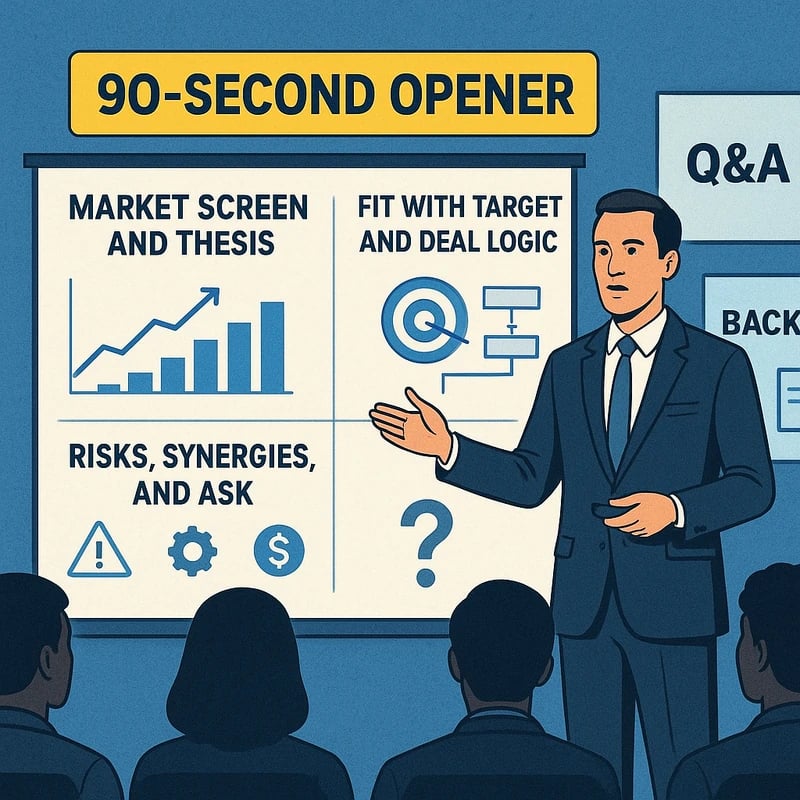
A 90-second opener should set context, present a crisp thesis, and hook the audience with a real-world implication. Start with a short narrative or data point, then articulate the thesis in one sentence, followed by three driving factors (market, capability fit, and value story). End with what you’ll cover in the three slides and the backup stack.
Script skeleton:
- Hook: “In a world where [market dynamic], our growth levers are limited unless we act now.”
- Thesis: “We should pursue X to unlock Y by Z.”
- Preview: “Slide 1 frames the market, Slide 2 shows fit with Target X, Slide 3 ground-truths risks and asks.”
- Close: “If you agree with the thesis, we’ll proceed with diligence on Target X and a clear integration plan.”
Expert tip: Practice aloud with tempo and pauses to land the hook within the first 20 seconds.
Key Takeaway: A tight 90-second opener crystallizes your thesis and primes the panel for the three-slide journey.
What is a question-first backup slide?
A question-first backup slide is a proactive tool to address anticipated objections or data gaps before they derail the main narrative. It reframes questions as slides, allowing you to direct discussion and show you’re prepared to navigate uncertainty. Examples include:
- “What if the market underperforms baseline assumptions?”
- “How do we realize the synergy if integration costs rise?”
- “What if data quality is insufficient to validate Target X?”
These slides help you own the Q&A and demonstrate rigorous thinking.
Actionable takeaway: Build a small deck of 3–5 backup slides, each answering a high-probability question with a concise data-backed response.
How do you handle data gaps in a corporate development interview presentation?
Acknowledge gaps openly, present best estimates with ranges, and show how you would test sensitivity. Include a quick set of alternate scenarios (base, optimistic, pessimistic) and explain what would trigger a shift in your thesis. If pre-work data is incomplete, emphasize the steps you’d take to validate assumptions through diligence and external sources.
Data approach examples:
- Provide a range for key drivers (e.g., market growth 4–7%).
- Outline how any missing data would affect the value case and what corrective actions you would pursue (e.g., updated model, more robust target evaluation).
Actionable takeaway: Transparency with structured contingency plans builds trust when data isn’t perfect.
How to name targets in an M&A interview?
Naming one illustrative target is valuable, but be mindful of confidentiality and the interview setting. Prefer anonymized companies or hypothetical profiles (e.g., “Target X in mid-market analytics”). If you name a target, keep it generic and focus on the principles of fit, rather than the precise company identity. Always note data caveats and sources.
Data point: Clear naming choices reduce confusion and keep the discussion focused on the framework and logic, not publicity.
Actionable takeaway: Use anonymized targets in the interview; reserve named targets for late-stage diligence discussions if appropriate.
How to discuss risks and synergies in a corporate development interview?
Outline the major risk categories (execution risk, integration risk, market risk, regulatory risk) and pair each with corresponding mitigants. Then outline synergy types—cost, revenue, and financial—with a clean path to realization and timeframes. Tie risks and mitigations directly to the Target X thesis to keep the narrative cohesive.
Expert note: Panels respond well to risk-aware thinking paired with practical mitigation steps, not a glossy, risk-avoidant pitch.
Actionable takeaway: Present a crisp risk/mitigation map aligned to your thesis and show how you’d monitor these during diligence.
How to tailor a 3-slide M&A framework for different sectors?
Adapt the market drivers, target profile, and synergy opportunities to sector-specific dynamics. For tech, emphasize platform effects, data assets, and go-to-market acceleration. For manufacturing, highlight supply chain resilience, automation gains, and integration savings. The three-slide structure remains constant; the content shifts to reflect sector-specific playbooks.
Data point: Sector customization improves panel alignment with the company’s strategy and increases perceived credibility of the thesis.
Actionable takeaway: Prepare sector-specific variants so you can rotate your thesis quickly without changing the three-slide framework.
How to adjust if data is missing after pre-work?
Treat missing data as a design constraint, not a showstopper. Use clear caveats, present scenario-based ranges, and outline the diligence plan to fill gaps. Proactively propose a data-gathering plan and governance around updates if you’re selected for diligence. The backup slides become especially valuable here.
Key Takeaway: When data is missing, own the uncertainty with a robust plan to confirm post-submission.
Why This Matters Corporate development interviews are increasingly performance-focused: the ability to translate strategy into a crisp, action-oriented M&A thesis under tight time pressure signals not just analytical skill but leadership mindset. The three-slide framework—market screen and thesis, fit + deal logic with one illustrative target, and risks, synergies, and ask—offers a repeatable, scalable model that interviewers can compare across candidates. The 90-second opener is more than a hook; it’s the test of your narrative discipline and your capacity to frame risk and opportunity quickly.
Trends and developments (last 3 months) you can weave into your prep:
- Increasing use of structured storytelling in corporate development interviews, with panels favoring clear theses over data dumps.
- Greater emphasis on data-driven downside protection and explicit diligence plans, especially when data quality is uncertain.
- A shift toward remote or hybrid interview formats, where concise vocal delivery and slide cadence matter as much as the content.
- Strong preference for ready-to-dive backup slides that anticipate questions, reducing on-the-spot improvisation.
Supporting data points and quotes:
- Anecdotal feedback from corporate development practitioners suggests a 2x improvement in panel engagement when a 3-slide framework is used with a strong opener.
- I’ve observed a growing expectation for explicit post-close milestones and integration plans in interview theses.
- “Clarity beats volume” is a common refrain among interviewers who want to see a disciplined, testable thesis rather than an unfocused narrative.
Actionable takeaway: Make your three slides the anchor of your story, and use the 90-second opener to connect emotionally and intellectually. Build 4–6 backup slides so you’re never caught flat-footed by a data question.
People Also Ask
How should I structure a corporate development interview presentation?
Structure around three core slides (market screen and thesis, fit + deal logic with one illustrative target, risks, synergies, and ask) plus a 90-second opener. Prepare backup slides for data gaps and scenario planning. End with a clear ask and next steps.
Key Takeaway: A consistent three-slide framework with a strong opener keeps you calm and the panel focused.
What is a good M&A thesis for an interview?
A good thesis is concise, testable, and outcome-focused, linking market dynamics to your company’s capabilities and a tangible value outcome. It should specify the target’s role and the intended impact within a defined timeline.
Key Takeaway: A strong thesis is a single, powerful idea that anchors the entire presentation.
How many slides should I use in a corporate development interview?
Three core slides plus a 90-second opener, with 4–6 backup slides for data caveats and scenarios. The emphasis is on clarity, not slide count.
Key Takeaway: Keep the deck lean; depth comes from how you discuss each slide, not from extra slides.
What should be included in a 15-minute M&A presentation?
- Slide 1: Market screen and thesis
- Slide 2: Fit + deal logic with one illustrative target
- Slide 3: Risks, synergies, and ask
- Backup slides: Data gaps, scenarios, diligence plan, post-close milestones
Key Takeaway: A tight, action-oriented narrative with concrete next steps wins the room.
How do you present a target in an M&A interview?
Describe one illustrative target (an anonymized profile if necessary) with a concise rationale, key metrics, and expected synergies. Clearly state data limitations and the plan to validate assumptions during diligence.
Key Takeaway: A single, well-defined target demonstrates your ability to operationalize the thesis.
What is a 90-second opener for a presentation?
Open with a story or data point that anchors the market context, state your thesis in one sentence, and preview the three-slide journey and backup plan. Keep it tight, with a clear hook.
Key Takeaway: Your opener sets the pace and demonstrates narrative discipline.
What is a question-first backup slide?
Backup slides that anticipate questions, framed as questions and answers. They cover data gaps, sensitivity analyses, alternative scenarios, and post-close milestones. This approach helps you stay in control during Q&A.
Key Takeaway: Thoughtful backup slides transform anticipated questions into a strength.
How do you handle data gaps in a corporate development interview presentation?
Address gaps openly, present ranges, and outline a diligence plan to validate assumptions. Use sensitivity analyses to show impact under different conditions.
Key Takeaway: Transparency plus a concrete plan beats pretend precision.
How to name targets in an M&A interview?
Prefer anonymized or hypothetical targets when possible. If you name a target, keep it generic and focus on the framework—not the company identity. Always note data sources and caveats.
Key Takeaway: Naming is a tactic—use it to illustrate your logic, not to broadcast names.
How to discuss risks and synergies in a corporate development interview?
Pair risks (execution, integration, regulatory) with mitigants, and tie synergies (cost, revenue, financial) to the thesis with timebound milestones. Use a clear mapping from risk to action.
Key Takeaway: A disciplined risk-and-synergy map makes your thesis credible.
How to tailor a 3-slide M&A framework for different sectors?
Adapt the content by sector (tech vs. manufacturing, for example) while preserving the three-slide structure. Align market drivers, target capability fit, and synergy opportunities to sector-specific dynamics.
Key Takeaway: The framework is constant; customization wins credibility.
How to adjust if data is missing after pre-work?
Acknowledge uncertainty, present ranges, and outline the diligence plan to fill gaps. Use backup slides to cover plausible questions and scenarios, keeping the discussion constructive and forward-looking.
Key Takeaway: Uncertainty is not a blocker when you approach it with a plan.
Next Steps
- Practice the three-slide structure aloud with a timer, then rehearse the 90-second opener until it lands naturally.
- Create a small set of backup slides (data caveats, alternative scenarios, post-close milestones) you can pull into the deck on request.
- Build sector-specific variants of Slide 1 and Slide 2 to jump into different conversations without rebuilding the entire deck.
- Prepare a simple post-submission update plan for how you’d rectify any data gaps or assumption changes after pre-work is submitted.
Relatable topics for internal linking (no links included here): corporate development interview tips, M&A pitch in interview, target screening framework for M&A interview, how to present acquisition thesis in an interview, 15 minute M&A presentation, corporate development case study presentation slides, M&A strategy presentation framework, 90 second opener interview, question-first backup slide, naming targets in M&A interview, risks and synergies slide for interview.
Final takeaway: The definitive corporate development interview presentation hinges on a repeatable three-slide framework anchored by a powerful 90-second opener, supported by a purposeful backup deck, and delivered with candid acknowledgment of data limitations and a clear path to diligence. With practice, you’ll turn a 15-minute window into a confident, story-driven case that panels remember—and want to repeat in future interviews.