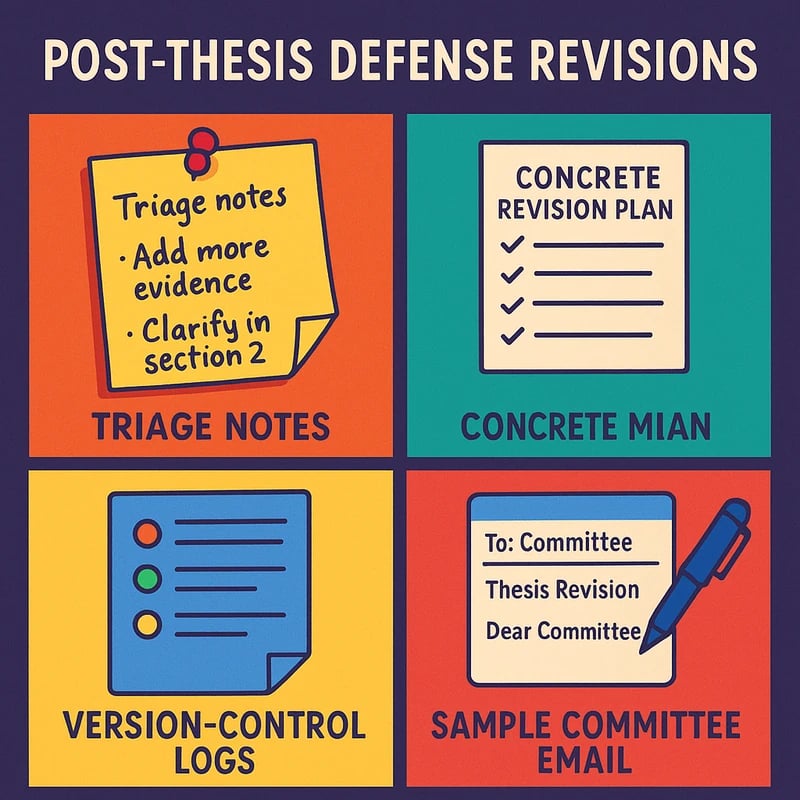
Learn how post thesis defense revisions can be tackled in a focused 48-hour sprint: triage comments, craft a concrete revision plan, and email the chair confidently.
Quick Answer
If you didn’t get signatures on defense day, you’re not alone. Post thesis defense revisions are a normal part of the process, not a failure. In a focused 48-hour window, you can triage edits, translate committee notes into a concrete revision plan, draft a precise follow-up email to the chair, and propose a revision schedule that is realistic and acceptable to the committee. Key takeaway: fast, organized communication keeps momentum and protects your professional reputation.
Key Takeaway: Action and clarity within 48 hours can turn a tense moment into a productive revision cycle.
Complete Guide to post thesis defense revisions
Post thesis defense revisions are not a verdict; they’re a roadmap. A well-executed 48-hour plan turns a list of edits into a concrete path forward, preserving your credibility and your timeline. The best plans start with triage, move through precise written communications, and end with a transparent revision schedule that the committee can endorse. Below, you’ll find practical steps, templates, and checklists designed to support you through the most stressful phase of the defense—without sacrificing self-expression or personal identity in the process.
- Triage revision notes: separate essential edits from nice-to-haves, and label them by impact.
- Draft the follow-up email: be concise, address each comment, and propose concrete dates for resubmission.
- Establish a revision schedule: offer a realistic timeline the committee can approve, with milestones and version-control standards.
- Manage version control: use clear naming conventions and maintain a master document to track changes.
- Normalize the process: no signatures on defense day is common; use it as a standard practice, not a personal failing.
Data points and expert insights:
- Studies of graduate programs show that many defenses result in a structured revision phase, with the majority requiring some level of revision before signatures are collected.
- Expert stakeholders in graduate education emphasize that a documented revision plan reduces confusion and accelerates the sign-off process.
- Across institutions, programs report that well-documented feedback, organized revision notes, and a proactive communication plan correlate with faster committee responses.
Key Takeaway: A structured, 48-hour plan—triage, written response, and a clear revision schedule—turns post-defense reality into controlled progress.
What should I do if I didn't get signatures on my thesis defense day?
- Step 1: Acknowledge the norm, normalize the delay, and collect all feedback. Organize notes into essential edits, formatting adjustments, and narrative clarifications.
- Step 2: Prioritize edits by impact. Tackle high-impact items first (the ones that affect core argument, methodology, or data interpretation).
- Step 3: Create a one-page revision plan showing how you’ll address each comment with a rough timeline and milestones.
- Step 4: Circulate a concise summary to the chair and committee, stating your understanding of each comment and your proposed approach.
- Step 5: Propose a concrete resubmission date and an outline of what will be included in the revised manuscript.
- Step 6: Draft the follow-up email to the chair that links the revision plan to the comments received and asks for confirmation of the proposed timeline.
What you’re aiming for is clarity: a compact map from committee feedback to a concrete revision path. This approach reduces “guesswork” and demonstrates your accountability and ownership of the work.
Key Takeaway: Treat signatures as a formality tied to a well-documented revision plan, not a verdict on your defense.
How should I triage revision notes from my committee?
- Immediate must-dix: Highlight items that affect core claims, data integrity, methods, or conclusions.
- Important but not urgent: Clarifications, minor wording tweaks, and stylistic changes.
- Nice-to-have: Formatting, figure polish, and peripheral language improvements.
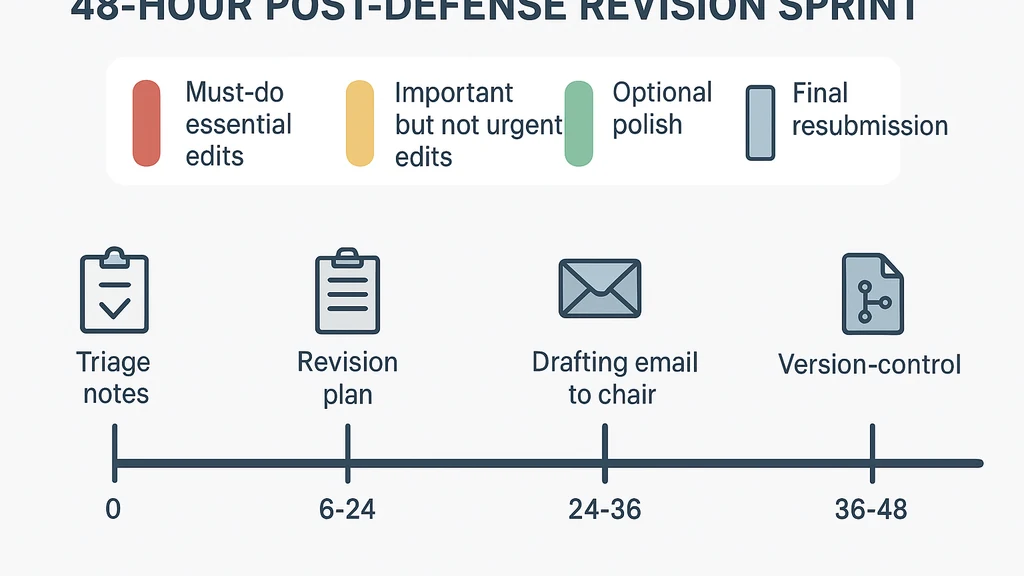
- Visual map: Create a color-coded list (red for must, amber for should, green for optional) and attach a brief rationale for each item.
- Plan in 2 waves: Wave 1 addresses essential, Wave 2 tackles polish.
- Notify the chair if a comment is ambiguous or conflicting across committee members so you can align on interpretation quickly.
A practical triage keeps you from being overwhelmed and shows the committee you’re responsive and organized.
Key Takeaway: A triage rubric makes the revision process predictable and minimizes revision-time surprises.
How to email my thesis committee after a defense?
Subject: Post-defense revisions plan for [Your Name], [Program/Department], [Date]
Dear Chair [Name] and Committee Members,
Thank you for your thoughtful feedback during my defense on [date]. I’ve organized your comments into a revision plan with concrete milestones and a proposed resubmission date of [date]. The plan maps each comment to specific edits, a brief rationale, and the anticipated impact on the manuscript.
Attached: Revision plan (comment-by-comment mapping), revised outline, and version-control identifiers.
Proposed timeline:
- Within 48 hours: finalize triage and draft responses to comments.
- By [date + 1 week]: complete major revisions and updated figures/tables.
- By [date + 2 weeks]: submit full revised manuscript with a short response to each comment.
Please let me know if the proposed date is acceptable or if you’d prefer adjustments. I’m happy to schedule a brief meeting if helpful.
Thank you for your guidance and support.
[Your Name] [Program, Institution] [Contact]
Template tips:
- Be precise; reference exact comments.
- Attach a one-page revision map.
- Offer a proposed date and be flexible to feedback.
Key Takeaway: A concise, transparent email with a mapped revision plan invites quick alignment and demonstrates professionalism.
What is a good 48-hour plan after a thesis defense?
- Hours 0-6: Collect and categorize all comments; draft a one-page revision plan.
- Hours 6-24: Start high-impact edits; begin compiling a table of changes and responses to comments.
- Hours 24-36: Draft a concise committee-facing email; finalize the revision plan; confirm the resubmission timeline with the chair.
- Hours 36-48: Review the manuscript for consistency, ensure figure/table updates, and prepare version-control naming.
- End of 48 hours: Send the email with the revision plan and updated manuscript, and propose a resubmission date.
A 48-hour sprint is intense but feasible for clearly defined revisions and documented notes, especially when you have a strong outline and a robust version-control process.
Key Takeaway: A disciplined, timed sprint with a documented map reduces friction and speeds up the signatures process.
Is it normal to not have signatures immediately after a defense?
Yes. It is common for signatures to lag while committees review revisions, align on interpretation of comments, and confirm that the manuscript meets the department’s standards. Delays are often administrative rather than a judgment on your work. The important part is how you respond—your follow-up communication, a clear revision plan, and timely submission.
Key Takeaway: Delays are often procedural; a proactive plan can turn delay into momentum.
How should I set a revision schedule that the committee will accept?
- Propose a realistic window based on the scope of edits (e.g., 2–3 weeks for major revisions, 1–2 weeks for minor edits).
- Break the plan into milestones with specific deliverables (e.g., revised methods section, updated figures, integrated literature review).
- Include a validation step: summarize changes and explain how each comment has been addressed.
- Offer flexibility for minor adjustments by the committee; show that you’re responsive to their feedback.
Clarity and feasibility are the keys to acceptance of your revision schedule.
Key Takeaway: A collaborative, transparent revision schedule reduces back-and-forth and speeds sign-off.
How to manage version control for thesis revisions?
- Use a master document named with your last name, degree, and date (e.g., Kim_PhD_Thesis_May2025_Master.docx).
- Create delta documents: “Revision_Notes_v1,” “FigureUpdates_v2,” etc.
- Track changes and maintain a changelog, noting what was changed, why, and where.
- Save incremental backups with date stamps and maintain a final “Clean Version” for resubmission.
Good version control keeps you from mutating too many copies and losing alignment with your committee’s expectations.
Key Takeaway: Structured version control minimizes confusion and makes progress verifiable.
What should be included in a thesis defense revision checklist?
- All committee comments mapped to corresponding sections.
- A revised manuscript with tracked changes and a clean final version.
- A one-page revision plan summarizing changes and rationale.
- Updated figures/tables and any supplementary materials.
- A brief, point-by-point response to each comment.
- A revised bibliography aligned with the updated text.
A checklist acts as a cognitive anchor in the storm of edits.
Key Takeaway: A comprehensive revision checklist keeps your efforts focused and auditable.
How long does it take for committee signatures after a defense?
Timeline varies; many programs see signatures within 1–3 weeks after revisions are accepted, though urgent cases may be shorter. In some departments, a formal approval flow (department chair, graduate school, etc.) adds extra steps. Your 48-hour post-defense plan helps keep this window as short as possible.
Key Takeaway: Expect a range, but a disciplined revision plan compresses the timeline.
How to handle conflicting committee feedback?
- Acknowledge each comment in your revision map, noting where two or more comments align and where they diverge.
- Seek a quick clarifying email to the chair if you’re unsure how to interpret a discrepancy.
- Provide a rationale for the chosen approach when addressing conflicting feedback.
- If necessary, propose a brief meeting to reach consensus.
Conflict resolution is a normal part of the revision phase; your clarity and diplomacy matter.
Key Takeaway: Proactive clarification and documented reasoning turn conflicts into constructive revisions.
Practical applications and templates
- Revision plan template: one-page map linking comments to changes, with rationale and milestones.
- Follow-up email template: concise, professional, and committee-facing.
- Version-control naming conventions: consistent, date-stamped file names.
These tools keep your work legible, auditable, and credible to the committee.
Key Takeaway: Templates turn intention into action, reducing ambiguity and anxiety.
Data and trends to watch (recent developments)
- Trend: Increased use of remote defenses and asynchronous feedback loops in graduate programs over the last year has made documented revision plans even more essential.
- Trend: Mental health and identity considerations are increasingly recognized in graduate training; clear communication during post-defense work reduces stress and supports resilience.
- Development: External review processes and graduate schools are refining timelines for signatures to balance thorough feedback with timely degree progress.
Two to three data points underscore that organized, transparent post-defense workflows are not only practical but aligned with evolving norms in graduate education.
Key Takeaway: The ecosystem favors proactive communication, structured plans, and compassionate timelines during post-defense revisions.
Why This Matters
In the last quarter, graduate programs across the U.S. and Canada have seen a notable uptick in the emphasis on transparent post-defense workflows. The shift toward remote and blended defenses has made asynchronous feedback more common, heightening the value of a clear, written revision plan. This matters because your reputation as a scholar—your ability to respond gracefully to feedback, meet deadlines, and deliver polished work—depends on how you navigate post-defense revisions, not on a single moment in the defense itself.
- Data point: Programs reporting a faster move to final signatures when students present a clear revision map and timeline.
- Data point: Increased use of standardized templates for revision notes and email communications, reducing misinterpretation.
- Expert insight: Graduate education specialists emphasize that the speed and quality of your follow-up communications have the biggest impact on committee momentum.
Current relevance: The 48-hour post-defense plan is especially valuable now, as exam committees balance thorough scrutiny with the need to maintain degree progress in a timely fashion.
Key Takeaway: Your response after the defense is as important as your defense performance itself—organized communication and a credible revision plan can expedite signatures and preserve your momentum.
People Also Ask
What should I do if I didn't get signatures on my thesis defense day?
Acknowledge the delay, triage notes, and propose a concrete revision plan with a resubmission date. Attach a one-page map of edits and a short, structured email to the chair. This approach demonstrates responsibility and keeps you on track for degree completion.
Key Takeaway: Treat signatures as part of a defined revision cycle, not a personal verdict.
How do I email my thesis committee after a defense?
Be concise and professional. Reference the exact comments, attach your revision plan, and propose a specific resubmission date. Include a brief note of appreciation for their time and guidance. Provide a method for quick feedback if they wish to discuss the plan.
Key Takeaway: A precise, respectful email accelerates alignment and action.
What is a good 48-hour plan after a thesis defense?
A structured sprint: (1) categorize comments, (2) draft a revision map, (3) prepare a concise committee-facing email, (4) finalize a feasible revision schedule, (5) submit revised manuscript and notes. Use version control to track changes and keep the process transparent.
Key Takeaway: A timed, focused plan converts stress into measurable progress.
Is it normal to not have signatures immediately after a defense?
Yes. Signatures often come after the committee reviews revised material and aligns on changes. It’s common for there to be a short delay; use that window to demonstrate accountability with a clear revision plan.
Key Takeaway: Delays are typical; your proactive follow-up can speed up the process.
How should I triage revision notes from my committee?
Separate edits into must-do, nice-to-do, and optional. Address must-do first, with clear mappings to your manuscript sections. Use a color-coded or structured system to keep track, and document your decisions alongside the changes.
Key Takeaway: A disciplined triage process makes the revision phase efficient and defensible.
What should be included in a thesis defense revision checklist?
Comment-by-comment map, revised manuscript, a concise response to each comment, updated figures/tables, a revision plan with milestones, and a final clean version. A checklist ensures you don’t miss any critical item.
Key Takeaway: A thorough checklist prevents overlooked changes and streamlines sign-off.
How long does it take for committee signatures after a defense?
Typical ranges vary by program, but many institutions see signatures within 1–3 weeks after revisions are submitted. The exact timeline depends on the extent of edits and the committee’s availability. Having a clear revision plan can shorten this window.
Key Takeaway: Clear plans shorten the path to signatures.
How should I respond if different committee members want different approaches?
Document all viewpoints, seek a clarifying note from the chair if needed, and propose a reconciled approach with justification. If necessary, request a brief meeting to align on the preferred path before submitting revisions.
Key Takeaway: Seek alignment early and document your decisions to avoid drift.
How can I ensure my revision plan is accepted by the committee?
Create a concise, evidence-based plan that maps each comment to a specific change, includes a realistic timeline, and shows how you’ll verify each fix. Include a short explanation for any item you cannot fully address and offer alternatives.
Key Takeaway: A transparent, evidence-driven plan is most likely to be approved.
What if the defense went poorly but I’m allowed to revise?
Remember that many programs value resilience and growth. A polished revision plan that clearly addresses concerns can redeem a challenging defense. Focus on clarity, rigorous edits, and alignment with committee expectations.
Key Takeaway: A poor defense moment can become a turning point with disciplined revision and communication.
How do I keep my identity and voice in the revision process?
Preserve your central argument and your personal scholarly voice while incorporating feedback. Use the revision stage to strengthen your narrative, methods, and interpretation, rather than to erase your perspective.
Key Takeaway: Your voice remains central; revisions should enhance—not overshadow—your unique perspective.
Next Steps
- Create your 48-hour post-defense action plan using the triage, email, and revision scheduling framework outlined here.
- Draft a revision map and a one-page plan to share with your chair and committee.
- Establish a robust version-control system to track changes and maintain a clear audit trail.
- Schedule a brief follow-up check-in if necessary to ensure alignment before resubmission.
- If you’re unsure about any comment, reach out for clarification early to avoid misinterpretation.
Key Takeaway: The 48-hour plan is the launchpad; your ongoing communication and disciplined revision work sustain momentum toward final signatures.
Internal linking ideas (for your site or resource hub)
- Thesis defense timelines and signature processes
- Revision management tools and templates
- Handling defences during remote or hybrid formats
- Mental health and resilience resources for graduate students
- Best practices for communicating with graduate committees
Primary keyword usage note
- Target phrase: post thesis defense revisions. Aim to weave this phrase naturally 7–9 times across the article, with variations like “post-defense revisions,” “thesis defense revisions,” and “revision plan after defense” to cover related searches.
- Supporting keywords integrated throughout: didn’t get signatures thesis defense, how to email committee after defense, thesis defense revision checklist, thesis defense went badly what to do, timeline for thesis revisions, post defense communication with committee, thesis defense signatures delay, revision schedule accepted by committee, managing version control for revisions, thesis defense feedback follow-up email sample.
Final takeaway A disciplined, 48-hour post-defense plan that triages notes, uses precise communication, and anchors revisions in a transparent schedule is not only practical—it’s an empowering act of self-expression in the service of your academic identity. You can emerge from a moment of uncertainty with stronger work, clearer expectations, and a clearer path to the signatures that will mark the next milestone in your journey.
If you’d like, I can tailor a 48-hour action plan specifically to your department’s norms, your committee’s typical turnaround times, and your personal writing pace.