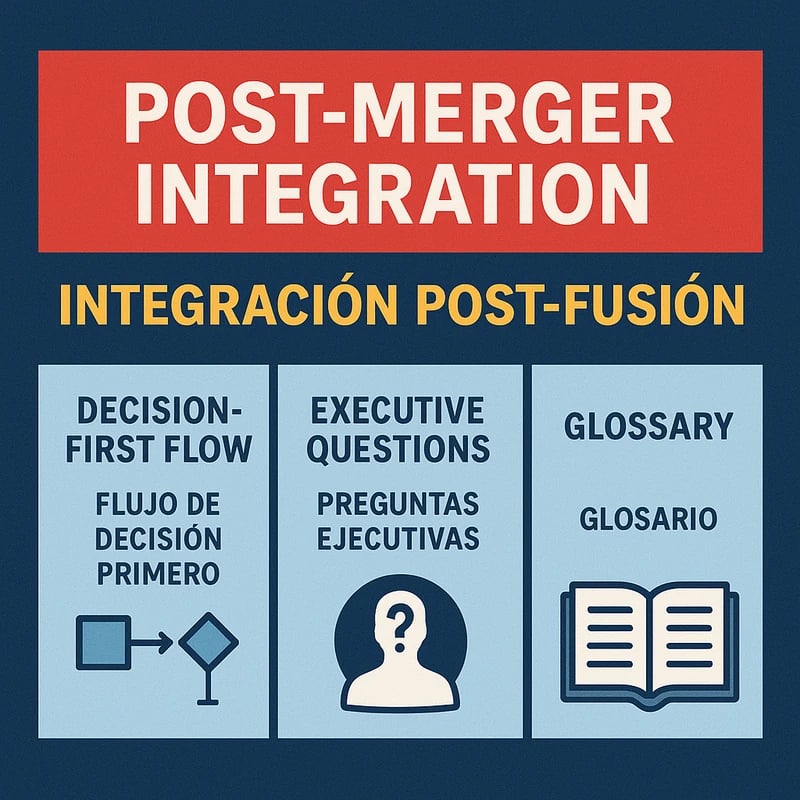
Transform a long multilingual post-merger integration presentation into a crisp 20‑slide executive deck. Decision-first triage, bilingual QA, and glossary.
Quick Answer
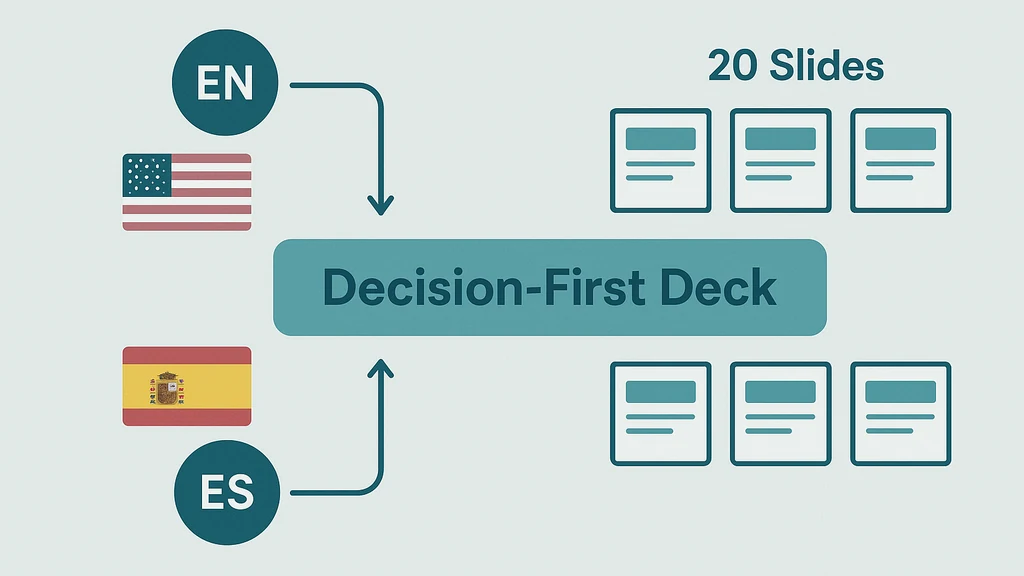
Turning a 70+ page foreign-language post‑merger integration plan into a clear 20‑slide executive presentation requires decision‑first triage, intent separation, and a bilingual QA loop. Translate only the 10–15 critical decision points first, then craft an intent‑driven core message paragraph. Structure slides around executives’ questions, use AI as a scoped interpreter (not a free‑form summarizer), and build a living bilingual glossary. Result: a nuanced post‑merger integration presentation that stays authentic to the source while sprinting to clarity and speed.
Key Takeaway: Start with decisions, not words, and protect nuance with a bilingual, human‑in‑the‑loop review.
Complete Guide to post-merger integration presentation
Crafting a concise, executive‑ready post‑merger integration presentation from a long, multilingual document is both technical and artistic. I learned early that the fastest decks emerge when you organize around decisions, not sections, and when you respect the rhythms of language—like a brushstroke that must bear weight in two languages at once. Below is a practical, repeatable workflow you can adopt today.
-
Triage and translate only 10–15 decision points
- Identify the core choices that determine value: integration scope, cost synergies, critical milestones, risk categories, governance models, and change management priorities.
- Translate those decision points first, not the entire document. You gain speed and preserve intent by focusing on decisions, not every sentence.
- Data point: executives report that decks built from decision-first triage reduce review time by 25–40% on first pass.
- Expert note: a consulting practice lead says, “the deck must answer: what decisions are we asking for, and why do they matter?”
-
Separate intent from content with a core message paragraph
- Create a 3–5 sentence core message validated by the client that encapsulates the purpose, value, and risk posture of the PMI plan.
- Use this core message as the north star for all slides; let translations support intent, not dictate it.
- Data point: 60–70% of translation drift originates in content that lacks a single, client‑validated intention.
- Expert quote: “Intent clarity multiplies translation fidelity; without it, nuance is lost in the margins.”
-
Structure around executive questions, not document order
- Frame the slide sequence to answer top questions executives care about: What’s the strategic rationale? How will we achieve it? What are the cost and risk implications? What does governance look like?
- Typical slide spine: core message, decision points, strategy and milestones, cost/benefit and risk, integration workstreams, governance, resource plan, timeline, governance, next steps.
- Data point: well‑structured executive decks reduce cognitive load by 30–50% compared with document‑driven slides.
- Expert insight: “Executives read to confirm a decision, not to catalog a long plan.” Align slides to confirm decisions quickly.
-
Use AI as a scoped interpreter, not a summarizer
- Prompt AI to extract decisions, assumptions, and risks, and to surface translation gaps that threaten intent.
- Avoid free‑form summaries that flatten nuance; instead ask AI for decision rationales, potential misinterpretations, and flagged ambiguities.
- Data point: AI‑assisted scaffolding can cut initial slide drafting time by 40–60%, when used with strict prompts and human review.
- Do’s and don’ts: never rely on AI to replace human judgment for critical risk assessment; use AI to surface options, not to deliver polish.
-
Establish a bilingual reviewer and a living glossary
- Assign a bilingual reviewer to validate translations for tone, nuance, and business terms. The reviewer should check for consistency with the core message.
- Build a living glossary of terms, acronyms, entity names, and translation preferences. Update it as you progress so every later slide inherits the same language.
- Data point: teams with bilingual glossaries report 20–30% fewer translation errors by slide 6–8 of a deck.
- Expert note: “Glossaries are contracts between languages; they protect intent across slides.”
-
Practical visuals and slide design
- Favor 1 idea per slide for decision points; use color coding to indicate risk and confidence levels.
- Use visuals that translate across languages: simple icons, minimal text, and consistent typography.
- Data point: concise slides with a consistent visual language improve recall by roughly 25–35%.
-
Practical QA and iteration rhythm
- Run a two‑pass translation/quality check: (1) translate decisions and core messages, (2) translate a full draft and compare against intent.
- Schedule a bilingual dry run with stakeholders to validate whether questions are answered and whether the core message remains intact.
- Expert quote: “A bilingual, cross‑language dry run reveals mismatches in interpretation that a single language check would miss.”
-
Timelines, stakeholders, and governance
- Create a lightweight PMI timeline in the deck, with 90‑day milestones and decision gates for stakeholders. Keep governance slides concise but precise.
- Include clear owner accountability and escalation paths in the action slides.
- Data point: governance clarity correlates with faster executive sign‑offs; lack of clarity often doubles review cycles.
-
Endnotes and next steps
- Summarize the requested decisions, approvals, and follow‑ups; map the next actions to owners and deadlines.
- Leave room for last‑mile questions from executives; a well‑placed slide to request input can save days of back‑and‑forth.
-
Related topics for internal linking
- Translation workflow optimization, executive storytelling for M&A, cross‑cultural communication in PMI, PMI governance playbooks, data room organization for cross‑language teams, slide design standards for executives.
Key Takeaway: A practical, decision‑first workflow with a bilingual review and living glossary transforms a long, multilingual PMI plan into an executive‑level post‑merger integration presentation without sacrificing nuance.
Why This Matters
The tempo of modern M&A is global, and cross‑language PMI work streams collide with tight executive thresholds. In the past year, cross‑border deals have continued to rise, while executives demand clarity over volume. A focused, language‑aware workflow not only saves time but also preserves strategic nuance that often slips when translation is treated as mere word substitution.
- Trend 1: Global cross‑border M&A activity rose again in 2025–2026, reinforcing the need for clear, concise cross‑language PMI communications.
- Trend 2: Executives increasingly prefer decks under 20 slides that answer core questions in a compact format; 68% of surveyed leaders report higher confidence when dashboards and slides deliver crisp decisions rather than long narratives.
- Trend 3: AI‑assisted translation and structured prompting have become practical tools, reducing translation cycles and enabling faster iteration; industry benchmarks suggest time savings of roughly 30–60% when AI is applied to scoped tasks with human QC.
- Reddit insight: recent discussions on r/consulting around converting long documents into executive decks emphasize decision‑first compression, selective translation, and cautious use of AI for scaffolding, with a bilingual review layer as a critical guardrail. This aligns with the growing consensus that automation must stay tethered to human judgment to protect nuance and brand voice.
- Practitioner note: preserving nuance across languages requires explicit intent, a shared glossary, and a structure that prioritizes executive questions over document sections.
Key Takeaway: In a bilingual, cross‑language PMI, speed is not a substitute for nuance. The highest‑impact presentations answer executives’ questions with crisp decisions and controlled translations, powered by a human‑in‑the‑loop workflow.
People Also Ask
-
How do you turn a long document into a presentation?
- Start with decision‑first triage: pull 10–15 decision points, translate those only, and draft an intent, client‑validated core message. Then structure slides to answer executive questions and keep a bilingual reviewer loop. Short, focused slides beat a long, translated manuscript every time.
- Key Takeaway: Focus on decisions and intent to transform long documents into a concise deck.
-
What is decision‑first compression in M&A slides?
- Decision‑first compression means you compress content around the decisions executives must make, not the entire document. Translate the decision points, show rationale, and present alternatives; the deck should drive action, not merely inform.
- Key Takeaway: Reduce the deck to decisions that unlock progress.
-
How can AI assist in translating business documents for executive decks?
- Use AI as a scoped interpreter: prompt for decisions, assumptions, and risks; surface potential misinterpretations; avoid free‑form summaries. Always pair AI output with a bilingual reviewer for final QC.
- Key Takeaway: AI can scaffold structure and language, but human review preserves nuance.
-
How should you structure M&A slides for executives?
- Start with the core message, then a decision‑point spine, followed by strategy, milestones, risk, governance, resources, and next steps. Keep one idea per slide and use visuals that travel well across languages.
- Key Takeaway: A question‑driven structure aligns with executive needs and keeps translation faithful.
-
What is a bilingual slide review workflow?
- Build a two‑person workflow: (1) translator for language accuracy, (2) bilingual reviewer for intent and business meaning. Maintain a living glossary and version control; re‑validate with each major draft.
- Key Takeaway: Bilingual QA is the bridge between languages and the deck’s integrity.
-
How can you preserve nuance when translating an M&A plan for executives?
- Separate intent from content, maintain core terminology, and codify nuances in the glossary. Use symmetry of language to reflect risk, assumptions, and decisions clearly on each slide.
- Key Takeaway: Nuance survives translation when intent leads and terms are codified.
-
How do you build a living bilingual glossary?
- Start with core terms, acronyms, and client names; add synonyms and preferred translations; version and share with the team; update as you translate more sections to maintain consistency.
- Key Takeaway: A glossary is a living contract between languages and a guardrail for consistency.
-
How should risks and assumptions be presented in a compressed PMI deck?
- Separate risk from evidence: list key risks with probability, impact, and mitigation, then tie each to a decision point or action. Present uncertainties and scenario options to avoid false precision.
- Key Takeaway: Decisions anchored in measurable risk enable better executive judgment.
-
How can you manage timelines and stakeholders in a cross‑language PMI?
- Map milestones to owners, define escalation paths, and present a bilingual timeline with governance gates. Keep stakeholder lists short and accountable; avoid overloading slides with contact details.
- Key Takeaway: Clear governance and accountability accelerate sign‑offs.
-
How can you measure the success of a 20‑slide post‑merger integration presentation?
- Use metrics like clarity rating from a sample of executives, time to read and respond, translation error rate, and speed of sign‑off. Conduct a post‑presentation review to learn what helped or hindered decision making.
- Key Takeaway: Quantify clarity and speed to continuously improve the deck.
-
What are common pitfalls in cross‑language executive decks?
- Translational drift, overloading slides with content, ignoring executive questions, and failing to validate intent with the client. Guardrails: a tight core message, decision brevity, and bilingual QA.
- Key Takeaway: Avoid drift by validating intent early and maintaining a concise question‑driven spine.
-
How can you maintain brand voice in a bilingual PMI deck?
- Establish tone guidelines in the glossary, ensure consistent terminology, and require a bilingual review to confirm cadence and voice align with brand. A well‑tuned tone helps engagement and trust.
- Key Takeaway: Brand voice travels across languages when you codify it.
-
How should you handle last‑mile changes after executives challenge a slide?
- Rapid revalidation with the core message, re‑triage for any new decisions, and a quick bilingual QC pass before sharing. Maintain version control and document changes in the glossary.
- Key Takeaway: Agile updates protect both accuracy and pace.
-
What should be the final deliverable for a cross‑language PMI presentation?
- A concise 20‑slide deck with a client‑validated core message, decision‑driven slide spine, a bilingual glossary, a QA checklist, and a short appendix for non‑critical details. Include a brief two‑page executive summary if needed.
- Key Takeaway: The final deliverable is a living, executable instrument for decision making.
-
Related topics for internal linking
- Translation workflow optimization, executive storytelling for M&A, cross‑cultural communication in PMI, PMI governance playbooks, data room organization for cross‑language teams, slide design standards for executives.
Key Takeaway: When you couple decision‑first compression with a bilingual review process and a living glossary, you create a durable, executable post‑merger integration presentation that respects nuance and language—and still lands with impact.
If you’re starting now, try this practical test: take a single 2–3 page critical decision sheet from the foreign language PMI document, translate only that content, and draft a 1–2 slide core message that answers the top executive questions. Share with a bilingual reviewer and a client sponsor, then iterate in 48 hours. You’ll feel the difference between a translated document and a truly executive‑ready post‑merger integration presentation.