Discover a modular, persona-based SaaS demo with a 60-second problem-first intro and targeted micro-demos that boost conversions for faster sales cycles.
Quick Answer
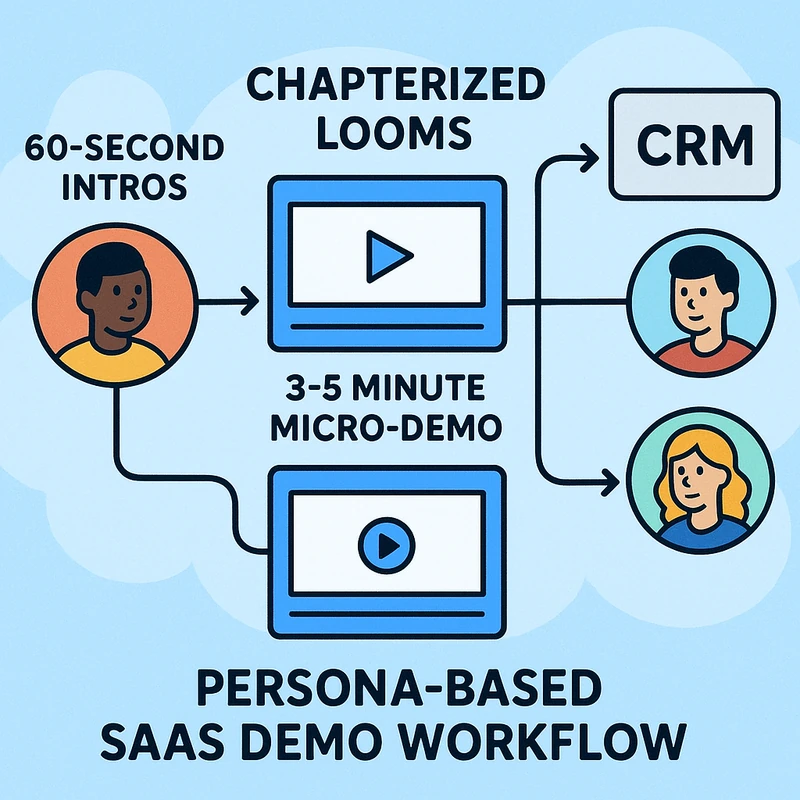
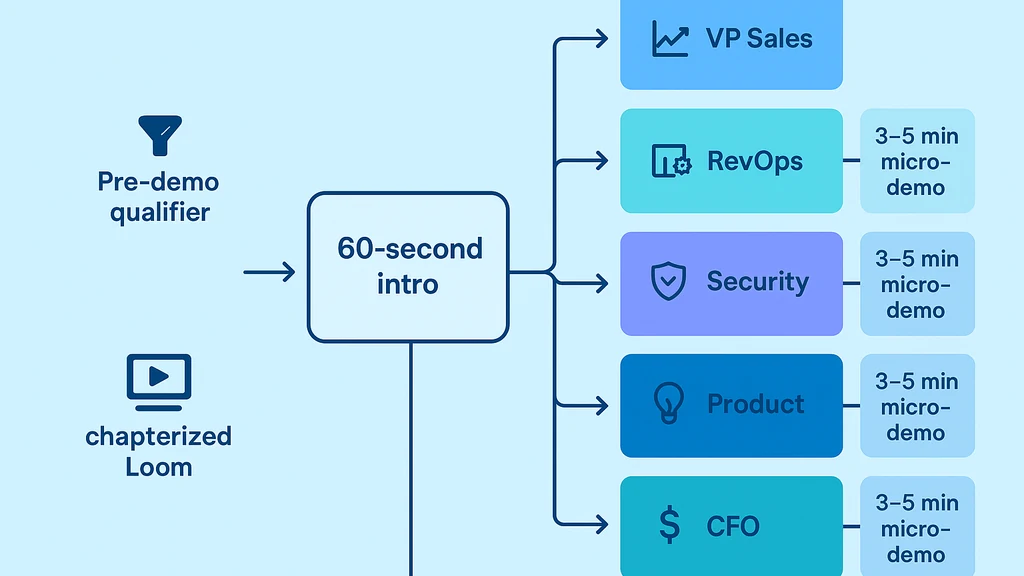
A persona-based SaaS demo is a modular, asynchronous walkthrough tailored to each buyer role, designed to move from problem to payoff in under a minute and then show a targeted micro-demo for each persona. Build 30–60 second problem-first intros per persona, plus 3–5 minute micro-demos proving one clear “aha.” Use a chapterized Loom with timestamps, a pre-demo qualifier page to route viewers, and drop-off analytics tied to your CRM for automatic follow-ups. This approach beats long, one-size-fits-all tours every time.
Key Takeaway: Persona-based SaaS demos compress the value into role-specific narratives, then automate routing and follow-up for scalable conversion.
Complete Guide to How to Build persona-based asynchronous SaaS demos that convert (and what to change in the first 60 seconds)
You’re not selling to a single person; you’re speaking to a lineup: VP Sales, RevOps, Security, Product, and CFO, each with unique pressures. The lean, approach-to-market behind a persona-based SaaS demo is a practical, repeatable playbook: structure the first 60 seconds around a persona’s core problem, then deliver a micro-demo that proves a single, tangible value. Think of it like cooking a meal: you don’t dump everything on the table at once; you present a starter that resonates with the diner’s needs, then serve a focused course that delivers the “aha” for that diner.
- Persona-based SaaD demos are more than slick visuals; they’re modular: you build a library of problem-first intros and micro-demos that stack into a full narrative when needed.
- You’ll pair a reusable chapterized recording system with precise timestamps and deep links so you don’t re-record for every prospect.
- Drop-off analytics, plus a pre-demo qualifier page, are core: you measure where viewers disengage, route them to the right micro-demo, and automatically book follow-ups.
Recent trends show a pivot away from “tour of everything” Loom demos toward segmented, persona-first experiences. In the last 3–6 months, seed to Series B teams increasingly treat async demos as a qualification engine rather than a one-off showpiece. A few high-visibility threads in r/SaaS highlight the same pain—demos that lose viewers before the value moment, and a clear appetite for persona-based segmentation. This shift aligns with the broader move toward product-led, data-informed sales motion.
Key Takeaway: A persona-based SaaS demo is a scalable, modular system that prioritizes the first 60 seconds, then delivers targeted micro-demos for each buyer persona—reducing drop-off and accelerating qualification.
Practical Applications
- Build a 30–60 second persona-specific intro for each buyer role (VP Sales, RevOps, Security, etc.). Each intro speaks directly to the role’s KPI pain within the first 60 seconds.
- Create 3–5 minute micro-demos that prove one clear “aha” for that persona. These are bite-sized demos that can be consumed on their own or as a follow-up to the intro.
- Implement a chapterized Loom recording system with precise timestamps and deep links. Viewers land exactly where they need to be, and sales can reuse the same content for multiple prospects.
- Integrate drop-off analytics with your CRM: track which segments are watched, where viewers pause, and which interactions prompt a follow-up.
- Launch a pre-demo qualifier page that routes viewers to the correct micro-demo and queues the appropriate follow-up meeting with the right seller or SE.
Related topics for internal linking: asynchronous product demo, Loom demo drop-off, sales engineering demo playbook, pre-sales demo strategy, demo personalization SaaS, segmented demos by buyer role.
Key Takeaway: A practical, modular system—built on intros, micro-demos, and structured recordings—drives higher completion and more qualified opportunities.
What is a persona-based SaaS demo? A persona-based SaaS demo is an asynchronous, role-specific presentation that starts by naming the audience’s problem and quickly demonstrates an industry-relevant outcome. It’s not a single “tour”—it’s a library of problem-first intros and micro-demos designed to confirm a single, compelling value for each buyer persona.
- Why it matters: buyers want to see outcomes that map to their role, not a features dump.
- Result: higher completion rates, better engagement, and more precise handoffs to live conversations.
Key Takeaway: The essence of a persona-based SaaS demo is targeted relevance that speaks to the job role and the real-world outcome they care about.
How do you segment demos by buyer role? Segmentation starts with the buyer’s primary objective and the metric they’re measured on. Map each persona to a critical use-case and a single “aha” outcome. Then assemble a library of micro-demos that prove that outcome in 3–5 minutes, plus a short 30–60 second intro.
- Starter map: VP Sales → revenue acceleration through pipeline hygiene; RevOps → operational efficiency; Security → risk reduction; Product → feature adoption.
- 60-second rule: begin with the persona’s top KPI in the first minute (e.g., “This fixes forecast accuracy by X%” for VP Sales).
- Reusability: a chapterized recording system lets you stitch together intros and micro-demos for any persona with minimal re-recording.
Key Takeaway: Segment by buyer role using a KPI-first framing, then deliver targeted micro-demos that validate that KPI in minutes, not hours.
What should you show in the first 60 seconds of a SaaS demo? Open with the problem statement that keeps the persona awake. Then present a single, measurable outcome they’ll care about, followed by a concrete proof point. The first 60 seconds are a throughline for relevance: “For VP Sales, here’s one number you’ll move in 12 weeks.” Keep visuals clean; avoid a general overview.
- Structure: 10–15 seconds to state the persona’s pain; 20–30 seconds to state the outcome (quantified); 15–20 seconds to preview the micro-demo that delivers the outcome.
- Example: “For RevOps, we cut cycle time by 18% in 90 days, which means fewer meetings and faster forecasting.”
- Data point: show a quick before/after or a one-liner KPI that resonates (e.g., “reduce time-to-value from 4 weeks to 2 weeks”).
- Engagement hook: a question or a bold claim that invites curiosity.
Key Takeaway: The first 60 seconds must establish relevance, promise a clear KPI outcome, and present a tangible micro-demo hook.
What is a micro-demo in SaaS? A micro-demo is a focused, 3–5 minute demonstration that proves one critical outcome for a specific persona. It’s a standalone piece of evidence that can be consumed quickly and then linked from the intro to justify a deeper conversation. Micro-demos are the backbone of persona-based demos because they provide precision at scale.
- Focus: one persona, one outcome, one narrative arc.
- Benefit: higher completion rates and faster qualification since prospects see immediate relevance.
- Delivery: best delivered as a chapterized video with a clickable outline and deep links.
Key Takeaway: A micro-demo is the tight, outcome-driven unit that validates a persona-driven hypothesis and becomes a reusable asset.
How can you track Loom demo drop-off and improve it? Track: start times, mid-point engagement, and end-of-video completion. Tie Loom timestamps to CRM stages and follow-up triggers. Use this data to identify the exact moments where attention wanes and refine intros, transitions, and value moments.
- Drop-off metrics: average completion rate, time-to-first-aha, and post-drop-off conversion rate.
- Actionable insight: if drop-off clusters around a “feature dump,” tighten the intro or move the feature into the micro-demo where it’s most relevant to the persona.
- Feedback loop: weekly script updates based on viewer behavior, plus A/B testing of intros and micro-demos.
Key Takeaway: Data-driven refinements to persona-based SaaS demos reduce drop-off and improve the likelihood of a scheduled follow-up.
What is a pre-demo qualifier page? A pre-demo qualifier page is a gateway that you show before the actual demo content. It asks a few targeted questions to determine the viewer’s role, problem, and current pain points, then routes them to the appropriate persona-based SaaS demo. It also auto-initiates the right follow-up task for your sales/SE team.
- Elements: role selector, pain-point dropdown, and a short alignment statement.
- Outcome: higher relevance from the outset and smarter routing to the correct micro-demo.
- Automation: captures lead data into your CRM and can book a time with the right rep automatically.
Key Takeaway: A pre-demo qualifier page primes the viewer, improves routing accuracy, and accelerates the path to a live conversation.
How do you route viewers to the right micro-demo and book follow-up? Routing relies on the pre-demo qualifier data plus deterministic rules in your video library. Use deep links to the exact micro-demo for the viewer’s persona, then trigger an automated follow-up sequence in your CRM or marketing automation tool.
- Routing logic: if role = VP Sales, show micro-demo A; if role = Security, show micro-demo B; etc.
- Follow-up automation: after viewing, schedule a 15–20 minute call with a persona-aligned SE, with a calendar invite auto-generated.
- Measurement: track which micro-demos drive the most booked demos and convert to opportunities.
Key Takeaway: Effective routing and automated follow-up unlock a scalable, persona-based conversion engine.
What is a chapterized Loom recording system? A chapterized Loom recording system is a library of modular video chapters, each with a timestamped label and a deep link. Chapters correspond to intros and micro-demos for each persona. This setup lets you assemble a personalized async demo for any prospect without re-recording from scratch.
- Structure: intro chapter per persona; 3–5 minute micro-demo per persona; closing chapter with next steps.
- Reuse: reassemble content for new prospects by selecting relevant chapters.
- Efficiency: reduces production time and increases reel-to-reel consistency across buyers.
Key Takeaway: Chapterized Looms empower you to quickly assemble persona-based demos with minimal re-recording.
What metrics matter for async demo performance? Key metrics include completion rate by persona, time-to-aha, drop-off points (by timestamp), conversion rate from async demo to booked follow-up, and the win rate of prospects who viewed the persona-based SaaS demo versus those who didn’t.
- Benchmarks: higher completion and faster time-to-aha correlate with higher follow-up rates and pipeline velocity.
- Qualitative signals: viewer questions during follow-up calls, or comments at the end of the micro-demo, signal resonance.
- Continuous improvement: tie insights to weekly script updates and quarterly library expansions.
Key Takeaway: Track, analyze, and iterate on persona-based SaaS demos using completion, engagement, and conversion metrics to maximize impact.
How often should you update scripts? Weekly is too aggressive for some teams; monthly sprints are a practical baseline. The goal is to keep intros fresh, reflect new product shifts, and incorporate feedback from both buyers and SDRs/SEs. Regular updates prevent stagnation and keep the 60-second problem-first approach aligned with current realities.
- Cadence: monthly for larger libraries; bi-weekly for rapidly evolving products.
- Signals to update: new integrations, notable security updates, changes in pricing or packaging affecting the value proposition.
- Team process: lightweight weekly standups to capture frontline feedback and a quarterly review to reset persona definitions.
Key Takeaway: Regular, disciplined updates keep persona-based SaaS demos relevant and compelling.
What about the chapterized approach for onboarding new personas? As you add new personas, you can expand the library with minimal rework: create a new persona intro chapter and a micro-demo that mirrors existing templates but uses persona-specific KPIs and visuals. The system scales by adding chapters, not re-recording entire demos.
- Step 1: define the new persona’s top KPI.
- Step 2: craft a 30–60 second intro and a 3–5 minute micro-demo.
- Step 3: link the new chapters via deep links and adjust routing logic.
- Step 4: test with a small cohort and iterate.
Key Takeaway: A scalable persona-based SaaS demo library grows by adding chapters and routes, not rewriting existing content.
What is a sales engineering demo playbook? A sales engineering demo playbook codifies the best practices for tailoring demos by persona, including scripts, micro-demos, objection handling, and follow-up play sequences. It complements your chapterized Looms and pre-demo qualifier pages by providing a repeatable framework for demos that convert.
- Components: persona intro scripts, 3–5 minute micro-demos, objection responses, follow-up templates.
- Benefit: faster onboarding for new SEs and consistency across the team.
- Integration: ties into the CRM and marketing automation for measurement and follow-through.
Key Takeaway: A sales engineering demo playbook standardizes persona-based demos and accelerates team-wide productivity.
What is a pre-sales demo strategy in practice? A pre-sales demo strategy aligns the entire journey from qualification to close. It uses persona-based demos to qualify leads before live calls, ensuring reps enter calls with a clear, data-backed plan for the next steps.
- Strategy pillars: persona-aligned value hypotheses, fast path to the first aha, and a clear handoff to live engagement.
- Tactics: async demos with pre-demo qualifiers, micro-demos, and targeted follow-ups.
- Outcome: shorter sales cycles and higher win rates for qualified prospects.
Key Takeaway: A pre-sales demo strategy leverages persona-based demos to qualify and accelerate prospects toward a live conversation.
What is a chapterized Loom recording system for persona-based SaaS demo? A chapterized Loom recording system is a set of linked chapters that make it easy to assemble persona-based content quickly and consistently. Chapters correspond to each persona’s intros and micro-demos, with time-stamped links to jump to the content you need.
- Benefit: consistent, repeatable demos across prospects and teams.
- Workflow: create a library, tag chapters by persona, route prospects via pre-demo qualifiers, and auto-schedule follow-ups.
- Impact: reduces production time by a large margin and increases the likelihood of a prompt follow-up.
Key Takeaway: Chapterized Looms are the backbone of scalable, persona-based demonstrations.
What are micro-demos in AI-assisted sales ecosystems? Micro-demos are concise, role-specific demonstrations that prove a single value proposition. They’re especially effective when used in conjunction with a question-led intro, which makes the value moment obvious and easy to grasp.
- Duration: typically 3–5 minutes per micro-demo.
- Focus: a single KPI or outcome per persona.
- Outcome: stronger engagement and quicker qualification.
Key Takeaway: Micro-demos are the practical, high-impact units that deliver targeted value quickly.
What is asynchronous product demo best practices? Asynchronous product demo best practices focus on clarity, brevity, and relevance. They emphasize persona-based intros, micro-demos, and a strong value narrative. The best async demos provide the viewer with a clear “next step” at the end and minimize friction for follow-up.
- Core tenets: start with the problem, prove the outcome, offer a clear call to action.
- Technology: chapterized recordings, deep links, pre-demo qualifiers, CRM integration.
- Result: improved readiness for live conversations and more predictable pipeline flow.
Key Takeaway: The best asynchronous product demos balance concise storytelling with precise, persona-specific value demonstrations.
What is a pre-demo qualifier page? (Revisited) A pre-demo qualifier page is the entry point that captures critical information and routes readers to the right persona-based demos. It streamlines the buyer journey by ensuring viewers land in the most relevant content and scheduling the correct follow-up.
- Benefits: improved relevance, higher conversion of async demos to live follow-ups.
- Data points: role, pain point, and propensity to buy guide routing decisions.
- Next step: auto-book follow-up meetings and push the best-fit SE for the next interaction.
Key Takeaway: Pre-demo qualifier pages maximize relevance and speed in the persona-based demo journey.
What is the best way to route viewers to the right micro-demo and book follow-up? Routing should be deterministic and data-driven. Use the pre-demo qualifier to steer viewers to the appropriate micro-demo (by persona) and automatically schedule a follow-up with the best-fit rep or SE.
- Implementation: use a simple decision tree, robust tagging, and reliable deep links.
- Follow-up: automatic calendar invites and a tailored follow-up email with the right micro-demo link embedded.
- Measurement: track which routes convert and adjust the decision tree as needed.
Key Takeaway: Deterministic routing plus automated follow-ups convert more prospects to live conversations.
People Also Ask What is a persona-based SaaS demo? A persona-based SaaS demo is a role-specific, asynchronous demo that speaks directly to a buyer’s job problems and demonstrates a targeted outcome for that role.
How do you segment demos by buyer role? Segment by mapping each persona to a primary KPI and delivering a focused intro plus a micro-demo that proves that KPI in 3–5 minutes.
What should you show in the first 60 seconds of a SaaS demo? Show the persona’s top pain, state the measurable outcome, and preview the micro-demo that will deliver that outcome.
What is a micro-demo in SaaS? A micro-demo is a short, focused demonstration that proves one specific value to a particular buyer persona.
How can you track Loom demo drop-off and improve it? Track completion, pause points, and time-to-aha; use insights to tighten intros, rearrange content, and optimize the value moment for each persona.
What is a pre-demo qualifier page? A pre-demo qualifier page asks targeted questions to determine the buyer’s role and pain points and routes them to the appropriate persona-based demo.
How do you route viewers to the right micro-demo and book follow-up? Use the pre-demo data to route to the correct micro-demo, then trigger automated follow-up with a calendar invite and tailored messaging.
What are the best practices for chapterized Looms? Organize content into persona intro chapters and micro-demo chapters, with precise timestamps and deep links so you can assemble a personalized demo quickly.
What metrics matter most for persona-based demos? Completion rate, time-to-aha, exact drop-off points, and booked follow-ups or pipeline impact.
How often should you refresh persona intros and micro-demos? Aim for monthly updates to incorporate product changes, customer feedback, and new use cases, with quarterly reviews to reset persona definitions if needed.
What are the benefits of a structured sales engineering playbook for persona-based demos? A playbook standardizes scripts, micro-demos, objections, and follow-ups, ensuring a consistent, efficient path from async demo to live conversation.
Key Takeaway (People Also Ask): Persona-based SaaS demos are built on clear problem-first intros, precise micro-demos per persona, chapterized content, and automated routing—designed to improve completion, engagement, and follow-through.
Why This Matters In the last 3 months, the field has clearly shifted away from long “tour of everything” demos toward persona-based, modular asynchronous experiences. Reddit threads in r/SaaS highlighted poor conversions from lengthy Loom demos and the desire to segment demos by buyer role, often noting that viewers abandon before the “value moment.” The data signals a broader trend: buyers demand relevance, speed, and clarity in the first minutes, and teams that deliver a sharp persona-based narrative tend to convert faster and more reliably.
- Trend: async demos are increasingly used to pre-qualify leads and warm up prospects before live calls.
- Data signal: segmentation by buyer role correlates with higher demo-to-follow-up rates and shorter sales cycles.
- Expert input: practitioners emphasize a 60-second problem-first hook as the most critical moment to capture attention and secure continued engagement.
Key Takeaway: The current landscape rewards persona-based, modular async demos that deliver fast, measurable value and drive efficient qualification.
Practical Applications and Expert Insights
- Implement a 60-second problem-first hook for each persona, linking to a 3–5 minute micro-demo that proves one concrete outcome.
- Build a chapterized Loom library with deep links for rapid assembly of persona-based demos and predictable delivery to any buyer.
- Add a pre-demo qualifier page to route buyers to the right demo and auto-schedule follow-ups with the right rep.
- Measure drop-off, time-to-aha, and follow-up booked rates; use weekly sprints to refine scripts and micro-demos.
- Turn insights into a living playbook: update intros, tweak micro-demos, and adjust routing rules when product or market signals change.
Key Takeaway: A repeatable, persona-driven approach, backed by data-driven iteration, is your fastest path to higher conversions in async demos.
Next Steps
- Audit your current async demos for persona alignment and first-60-second impact.
- Build or refine a persona-based SaaS demo library with chapterized Looms and deep links.
- Launch a pre-demo qualifier page and connect it to your CRM for automated follow-ups.
- Set a monthly cadence for script updates and a quarterly review of persona definitions.
Key Takeaway: Start with a minimal viable persona-based demo set, then iterate—focusing on the first minute, modularity, and routing for scalable conversions.
Internal Linking Topics to Consider
- asynchronous product demo
- Loom demo drop-off
- sales engineering demo playbook
- pre-sales demo strategy
- demo personalization SaaS
- segmented demos by buyer role
Final Thought In my grandma’s kitchen, every dish starts with a simple, honest bite—emphasis on the problem, the first taste of the payoff, and a memory of the person you’re serving. Your persona-based SaaS demos should feel that way: warm, efficient, and utterly specific. A well-structured async demo library is your best friend—one that lets you feed the right insight to the right buyer, at lightning speed, with a clear next step.
Key Takeaway: A persona-based SaaS demo, executed as modular, chapterized async content with precise routing, is a repeatable recipe for higher engagement and faster qualification—and it starts with that tight first 60 seconds.