Learn how a 3-hour presentation uses a two-deck system: Deck A for live facilitation and Deck B as a handout, with 6 blocks, breaks, and takeaways.
Quick Answer
Design a 3-hour presentation with a practical two-deck system: Deck A for live facilitation (visuals, minimal text) and Deck B as a leave-behind handout (reference-grade detail). Build around 6 learning blocks of 18 minutes each, interleaved with three 10-minute micro-breakouts and two 20-minute breaks, plus a short wrap. Aim for 40–60 slides in Deck A and a concise 6–12 page Deck B handout. This keeps adults engaged while producing a durable resource.
Key Takeaway: A modular, two-deck approach with 15–20 minute blocks and balanced breaks is proven to sustain attention and create useful takeaways in a 3-hour presentation.
Complete Guide to 3-hour presentation
A well-structured 3-hour presentation isn’t a chaotic convoy of slides; it’s a deliberate, modular system that blends content with practice. The core idea is simple: explain, do, debrief in repeatable blocks, and support every block with a clean handout that teams can reference later. The two-deck approach (Deck A for live facilitation, Deck B as a detailed reference handout) helps you slide between energy and depth without overloading your audience or your slides. Below is a practical blueprint you can adapt for product managers, engineers, analysts, and L&D partners leading long-form training.
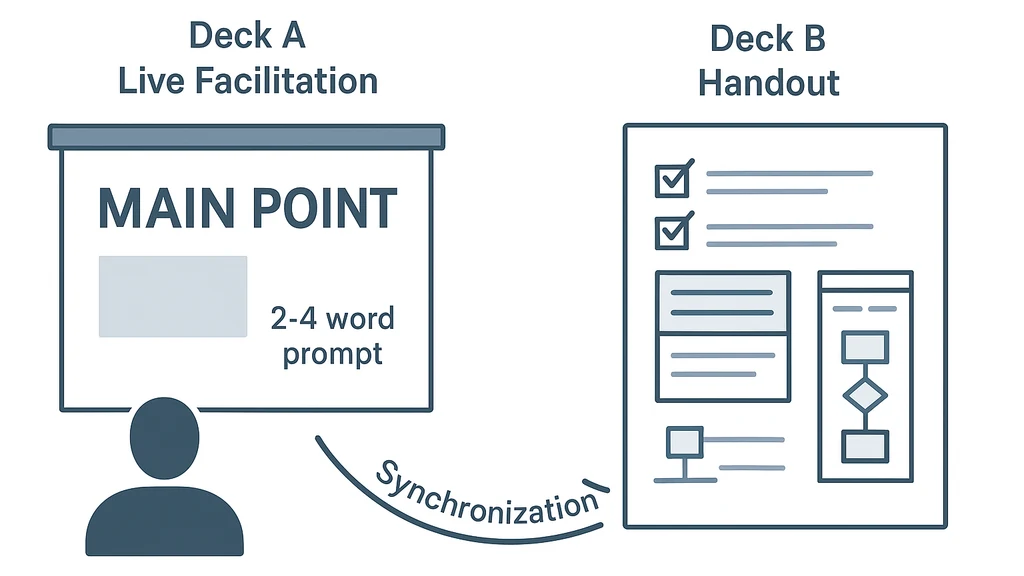
Two-deck system explained
- Deck A (projected): Visual, minimal text, built for facilitation. Think large typography, bold keywords, and clear prompts for activities. Use one core idea per slide, with 2–4 words max per line and a single, scalable diagram or graphic per slide.
- Deck B (leave-behind): Detailed, reference-grade handout. This is your post-event resource: step-by-step checklists, definitions, datasets, templates, and longer-form explanations. Each block corresponds to a Deck A slide or two, plus expanded notes.
- Synchronization: Before the session, map each Deck A slide to its Deck B page. After each block, hand out Deck B pages that recap the concepts and provide practice steps, checklists, and follow-up actions.
Practical learning block structure
- Explain > Do > Debrief: Each block should be 18 minutes long (give or take a few minutes), with a clear transition to a brief application activity and then a reflective debrief. This rhythm aligns with how adults process new information and apply it to real work.
- Activity ratio: Plan about 60–70% of each block as hands-on or discussion (the “Do” portion) and 30–40% as explanation and debrief. This keeps energy high and reduces cognitive fatigue.
- Energy checks: Embed quick checks every block (thumbs up, poll, or a one-sentence recap) to confirm understanding and adjust pace if needed.
Recommended 3-hour agenda template (sample)
- Block 1 (18 minutes): Explain core concept, 6-minute micro-demo, Debrief 3 minutes. Breakout prompt prepared for the next segment.
- Breakout 1 (10 minutes): Quick, structured discussion or problem-solving task in small groups.
- Block 2 (18 minutes): Build on Block 1 with a practical task, show a quick live example, Debrief 3 minutes.
- Break (20 minutes): Short energy reset, refreshments, and optional asynchronous reflection.
- Block 3 (18 minutes): Apply concept to a real-world scenario, Debrief 3 minutes.
- Breakout 2 (10 minutes): Reflection and synthesis in groups.
- Block 4 (18 minutes): Deep-dive activities, templates introduction, Debrief 3 minutes.
- Break (20 minutes): Movement, stretch, question capture for Deck B notes.
- Block 5 (18 minutes): Collaborative exercise, quick win checklist, Debrief 3 minutes.
- Breakout 3 (10 minutes): Final synthesis and action planning.
- Block 6 (18 minutes): Consolidation, final Q&A, Debrief 3 minutes.
- Wrap and Next Steps (2 minutes): Close with a concrete post-session action plan.
Key student-engagement tactics
- Micro-breakouts: Short, structured discussions that yield concrete outputs (e.g., a decision, a checklist, a sketch).
- Interactive prompts: Polls, quickwrite, or live problem-solving to keep attention anchored to real work.
- Visible energy checks: A quick 1–2 minute pulse check after each block to adjust pace and activities if needed.
- Real-work templates: Deck B should include ready-to-use templates, checklists, or playbooks that participants can apply immediately.
Quantitative guidance (for planning and pacing)
- Slide density: 40–60 slides in Deck A for a 3-hour session is a practical ceiling; use visuals and minimal text to let you guide the session rather than read slides.
- Handout depth: Deck B should be 6–12 pages per module or block, with short explanations, checklists, and space for notes.
- Break and breakout cadence: Two 20-minute breaks and three 10-minute breakouts generally fit a 3-hour window while preserving attention and providing intentional resets.
- Debrief time: 2–5 minutes per block allows participants to articulate what they learned and how to apply it, reinforcing retention.
Why this approach works
- Active learning boosts retention: In practice, participants who engage in practice tasks remember and apply concepts more accurately than those who only listen to lectures.
- Cognitive load management matters: Chunking content into 15–20 minute blocks minimizes overload and helps learners integrate new ideas with prior knowledge.
- Handouts increase transfer: A well-crafted Deck B handout acts as a reference guide, preventing the need to sprint back to a slide deck after the session ends.
Templates and templates that ship fast
- Run-of-show template: A ready-to-fill timetable with block numbers, durations, breakouts, and handout references; exportable to both Deck A and Deck B.
- Slide-to-activity ratio chart: Quick reference showing how many slides you should use per block (generally 4–6 slides for Explain, 1–2 slides for Debrief prompts).
- Breakout prompts bank: A short list of 10 structured prompts designed to drive practical outcomes (problem-solving, prioritization, decision reviews).
- Handout skeleton: A one-page “Block Summary” per block that includes objective, steps, templates, and next actions.
Sample agendas and templates for fast shipping
- 3-hour agenda with 6 blocks, 3 micro-breakouts, and 2 long breaks (as above) plus a concise Deck B handout per block.
- A “2-deck ship kit” including a Deck A storyboard (slides) and a Deck B one-pager per block, plus an end-of-session resource page.
- A customizable 3-hour workshop agenda template that adapts to different SMEs or topics while preserving the explain–do–debrief rhythm.
Key Takeaway: A disciplined block-based rhythm, supported by two synchronized decks, creates a predictable, engaging flow for a 3-hour presentation that doubles as a practical, referenceable handout.
Why This Matters In the current landscape, organizations increasingly blend live training with post-event reference materials. Hybrid formats demand a design that preserves engagement during live delivery while producing durable, shareable resources for later use. The two-deck plan and modular blocks directly address this need: facilitators stay focused, participants stay engaged, and the resulting handout becomes a portable reference for weeks to come.
Recent developments and trends (last 3 months)
- Hybrid-first training: More teams are designing sessions with a clear separation between live facilitation and post-event reference material to support asynchronous follow-through.
- Micro-learning revival: Short, outcome-focused modules inside longer sessions help with retention and transfer to job tasks.
- Facilitation tooling: New templates and run-of-show blueprints are becoming standardized for long-form internal trainings, enabling non-trainer SMEs to deliver consistent, high-quality experiences.
Expert insights to inform your design
- Active participation beats one-way delivery for long sessions.
- Chunking content into 15–20 minute blocks aligns with typical attention cycles.
- A durable handout reduces post-training friction and accelerates real-world application.
Key Takeaway: Aligning live facilitation with post-session reference resources is now an essential best practice for 3-hour presentations and longer.
Practical applications
- Use the two-deck system in real scenarios: a product kickoff, an engineering review, or a cross-functional skills update. The deck A visuals guide discussion; deck B pages capture concrete steps, templates, and checklists your teams can import into their workflows.
- For a 3-hour workshop in a fast-moving department, the handout can include a field-ready checklist, a decision log, and a one-page owner map that assigns follow-ups. This reduces post-session drift and accelerates impact.
- When working with non-trainer SMEs, provide a plug-and-play agenda and a block-by-block handout. This reduces the cognitive load on the facilitator and delivers a repeatable, scalable training process.
Key Takeaway: The two-deck model simplifies delivery for first-time facilitators and ensures that the training remains both engaging and actionable.
Common Questions (People Also Ask)
-
How many slides should you have for a 3-hour presentation? Answer: Aim for 40–60 slides in Deck A, prioritizing visuals and concise prompts. Keep text minimal and use slides to reinforce, not to narrate every point. Key Takeaway: Slower slide cadence with purposeful visuals sustains attention and clarity.
-
What is the explain–do–debrief learning block? Answer: Explain briefly to anchor a concept, do a hands-on activity to apply it, and debrief to capture insights and lessons learned. This cycle reinforces understanding and transfer. Key Takeaway: The explain–do–debrief loop is the backbone of the 3-hour presentation rhythm.
-
How can I design a training handout that doubles as a reference guide? Answer: Build Deck B to mirror each learning block with concise explanations, step-by-step tasks, templates, and clear next actions. Make it skimmable and easy to annotate. Key Takeaway: A well-crafted handout extends learning beyond the room and accelerates implementation.
-
What is a two-deck presentation system? Answer: Deck A is your live-facilitation deck (visuals, prompts), and Deck B is the detailed reference handout. They’re synchronized so participants can reference the material after the session without relying on memory alone. Key Takeaway: The two-deck system bridges live delivery and durable, post-session value.
-
How long should breaks be in a 3-hour workshop? Answer: Plan two longer breaks (20 minutes each) and three shorter 10-minute micro-breakouts or reflections. Breaks help maintain energy and support cognitive processing. Key Takeaway: Thoughtful breaks sustain attention and improve application of new ideas.
-
What activities engage adults in training sessions? Answer: Structured micro-breakouts, problem-solving tasks, real-work simulations, and quick reflections that tie back to actual job tasks. Adults learn best when they practice and see relevance. Key Takeaway: Adult engagement hinges on relevance, practice, and clear outcomes.
-
How do you keep adults engaged during long trainings? Answer: Use a clear block structure, interactive activities, accessible handouts, and energy checks. Keep content relevant and actionable, and limit slide density in favor of practice. Key Takeaway: Engagement comes from relevance, practice, and predictable pacing.
-
How should a 3-hour workshop run be structured? Answer: Six 18-minute blocks, three 10-minute breakouts, two 20-minute breaks, and a brief wrap. Each block follows explain–do–debrief with a handout aligned to the block content. Key Takeaway: A consistent rhythm with supportive handouts yields higher retention and satisfaction.
Next Steps for you
- Try a 3-hour pilot: Build Deck A and Deck B for a topic you know well, and run it with a small internal group. Refine the block timings based on feedback and energy levels.
- Create a template library: Save a few block templates, breakout prompts, and Deck B page layouts so you can ship a new 3-hour session in days rather than weeks.
- Instrument the session: Collect quick post-session feedback with a short form focusing on engagement, usefulness of Deck B, and applicability of the learnings.
Key Takeaway: A disciplined, repeatable 3-hour workshop blueprint—backed by a two-deck system and modular learning blocks—lets you ship fast, keep adults engaged, and deliver durable training resources.
Related topics for internal linking (concepts to explore later)
- Adult learning principles and facilitation tips
- Hybrid training design and asynchronous post-event resources
- Micro-learning and spaced repetition in corporate training
- Breakout design and group dynamics in large sessions
- Handout design best practices and templates
- Slide design for facilitation and executive summaries
- Measuring training effectiveness and post-training impact
- Run-of-show templates for workshops and all-hands sessions
Overall takeaway A 3-hour presentation can feel long, but a disciplined, modular design makes it feel manageable and meaningful. The two-deck system—Deck A for live facilitation and Deck B for a durable, reference-friendly handout—paired with 15–20 minute learning blocks and deliberate breaks, creates an experience that’s engaging in the moment and incredibly useful after the session ends. If you ship this approach, you’ll deliver a training that not only informs but also empowers attendees to take action—the mark of a truly effective 3-hour presentation.