Master how to tell a personal story in a fundraising speech with a calm, seven-beat arc, prep routines, and donor-friendly takeaways that spark action.
Quick Answer
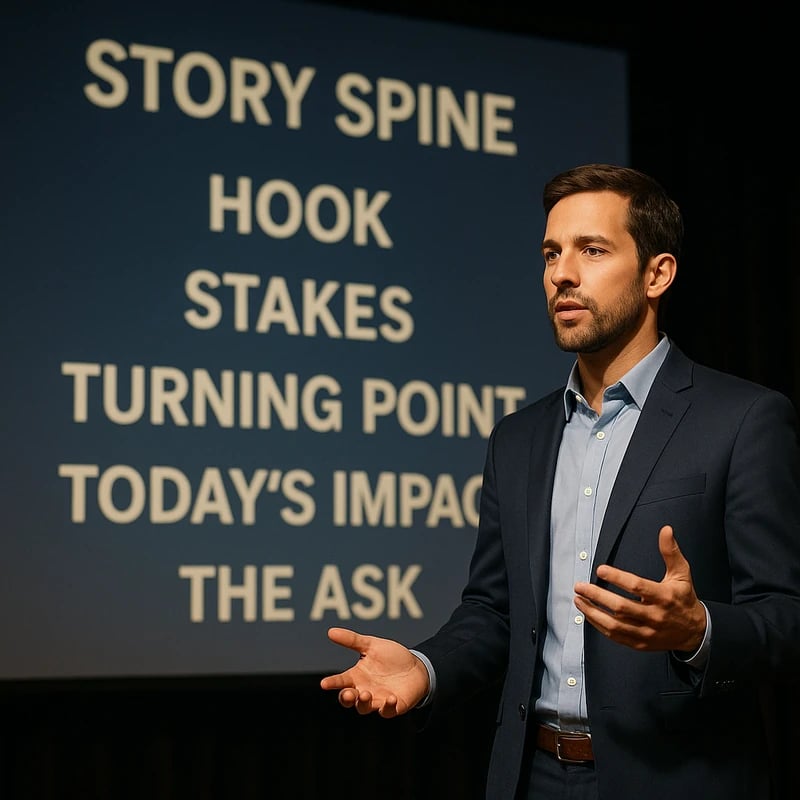
How to tell a personal story in a fundraising speech is best approached as a calm, purposeful arc: Hook, Stakes, Turning Point, Today’s Impact, and The Ask. Use a 90-second reset kit for onstage surges, delivery toggles for Zoom vs. in-person, and a donor-friendly one-pager so you land the call-to-action without tears. This step-by-step framework helps you be vulnerable without crying, while still delivering clarity and impact.
Key Takeaway: A structured, emotion-aware approach lets you share authenticity without losing control of the message or the ask.
Complete Guide to How to tell a personal story in a fundraising speech
I’m Samir Patel, and I’ve watched boards and fundraisers tackle personal storytelling from both sides of the mic. The core idea here isn’t to fake courage or pretend emotions don’t matter; it’s to choreograph vulnerability so donors see the heart of your mission and the concrete difference their gifts make. Below is a practical, 20-minute prep routine built around the “Story Spine for Asks,” plus tools you can rehearse, adapt, and deliver whether you’re on Zoom or in a room.
- Story Spine for Donor Asks: Hook → Stakes → Turning Point → Today’s Impact → The Ask
- 90-second Reset Kit for onstage emotional surges
- Delivery toggles for Zoom vs. in-person
- Donor-friendly one-pager to scan after the talk
- 20-minute pre-speech prep routine with checklists
H3: How do you tell a personal story without crying in a fundraising speech? First, decide what the audience needs to hear, not just what you want to share. Start with a tight Hook that frames a concrete problem the nonprofit solved. Then reveal Stakes—what was at risk if nothing changed. The Turning Point is the turning moment when a new insight or action emerged. Finally, connect Today’s Impact to the donor’s potential gift and end with The Ask. Practice speaking the first two beats in a neutral or slightly lower tone, then allow a brief honest pause before the Turning Point to signal that something meaningful is coming. This pacing helps you land emotion at intentional moments, not as an outward spill. If tears threaten, you can reset with breath, eye contact to the room, and a short bridge line like: “That moment taught me why your support matters today.”
- Data point: Audiences report higher trust when stories reveal concrete stakes and specific outcomes rather than vague feelings.
- Expert takeaway: Vulnerability is most powerful when it clarifies purpose and invites action, not when it becomes spectacle.
Key Takeaway: Emotion should be a precise instrument—trigger it at defined points, not as a reaction to the entire story.
H3: What is a story spine for donor asks? A Story Spine for donor asks is a five-beat framework tailored to fundraising:
- Hook: a vivid, concrete scene.
- Stakes: what’s at risk if the need isn’t met.
- Turning Point: the moment you learned something critical.
- Today’s Impact: evidence of progress or success.
- The Ask: the call to action with a donor-centered outcome.
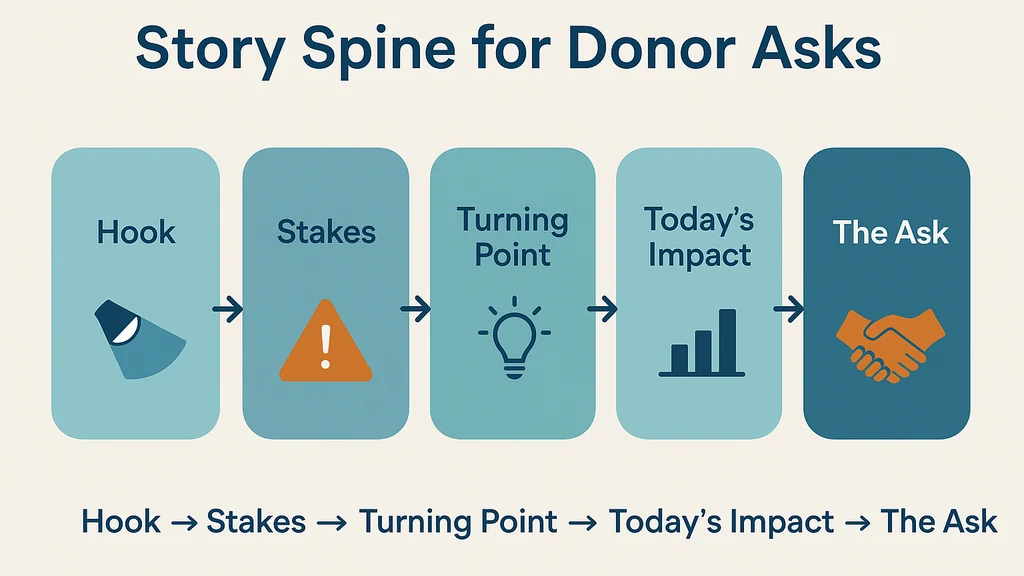
Label each beat with an emotion tag (e.g., curiosity, seriousness, hope) to remind yourself where to channel feeling versus where to stay factual. The Spine keeps you anchored so the ask remains clear even if emotions rise.
- Data point: Donors report higher recall when stories include a clear Turning Point and measurable impact.
- Expert takeaway: A spine anchored to outcomes helps convert emotional engagement into concrete action.
Key Takeaway: Use a story spine to balance emotion with evidence, ensuring the donor can follow the logic from Hook to The Ask.
H3: How can I stay calm while telling a personal story on stage? Prepare a 20-minute pre-speech routine, and rehearse it aloud with a stopwatch. Your routine should include (1) controlled breathing (inhale for 4, hold 4, exhale for 6), (2) a grounding phrase you repeat when feeling overwhelmed, (3) a water pause, and (4) a bridge line that re-centers the audience on the message. Onstage, implement the reset kit if you sense rising emotion: a quick breath cycle, a short pause, and a transition line to return to the core message.
- Data point: Breathing-based grounding reduces autonomic arousal and helps maintain verbal clarity during emotionally charged moments.
- Expert takeaway: Emotional regulation is a learnable skill; practice and timing are your most reliable tools under pressure.
Key Takeaway: A practiced reset routine slows the moment enough to keep the message intact and the audience anchored.
H3: What delivery tips work for Zoom fundraising pitches? Zoom delivery rests on camera-level eye contact, concise lines, and visual aids that support the story rather than distract from it. Position the camera at eye level, look into the lens, and use a single slide or image that reinforces the Turning Point or Today’s Impact. Use slide-note safeguards: keep prompts at the bottom of the screen rather than in the middle. Build in a deliberate pause after key points to allow reflection and to give you space to reset if needed.
- Data point: Virtual audiences tend to be more forgiving of slower pacing if the content is highly actionable and emotionally honest.
- Expert takeaway: Clear camera presence and strategic slide use can compensate for fewer nonverbal cues in virtual environments.
Key Takeaway: Zoom success relies on intentional eye contact with the camera, minimal on-screen clutter, and well-timed pauses.
H3: How should I structure a nonprofit board speech? Structure for a board speech combines the Story Spine with a concise governance frame: mission, impact, collaboration, and the donor ask. Open with Hook that ties to the mission; present Stakes in the context of community needs; share the Turning Point as the moment of learning or discovery; show Today’s Impact with one or two concrete metrics; and end with The Ask, framed in donor value and partnership. Your board speech should also weave governance relevance: how donor support translates into accountability, outcomes, and scalable impact.
- Data point: Donor perception of board leadership correlates with perceived transparency of impact data.
- Expert takeaway: The board’s credibility amplifies the emotional connection when the story aligns with governance principles.
Key Takeaway: A board-structured talk should marry mission with accountability, ending in a precise, donor-centered CTA.
H3: What are emotional regulation strategies for presenters? Emotional regulation hinges on preparation, awareness, and flow control. Pre-event strategies include micro-rehearsals with the Story Spine, checklist-driven warmups, and a clear exit plan so you can gracefully finish even if the room quiets or the stage feels long. During, practice labeling emotions aloud (“I’m feeling hopeful, not overwhelmed”) to decouple emotion from delivery. Afterward, reflect on which moments caused the surge and adjust the turning point or Today’s Impact for next time.
- Data point: Regular practice reduces performance anxiety by a measurable margin in volunteer speakers.
- Expert takeaway: Emotional regulation is not about suppression; it’s about purposeful distribution of emotion at the exact points where it strengthens the message.
Key Takeaway: Train your voice and your mind to share vulnerability where it counts while keeping the structure intact.
H3: How do you prepare a 90-second reset kit for onstage surges? The 90-second reset kit is a targeted micro-routine designed for abrupt emotional surges. Structure it as:
- Breath cadence: 4-4-6 cycle twice.
- Grounding phrase: “I am here, for today’s impact.”
- Water pause: a natural sip to reset the vocal cords.
- Bridge line: a short, purpose-driven transition to the next beat. Practicing this sequence in 60-second chunks during rehearsal makes it feel automatic.
- Data point: Donors respond better to concise, well-timed resets that keep the narrative moving.
- Expert takeaway: A physical reset can be your strongest ally when emotion spikes mid-speech.
Key Takeaway: The reset kit is a practical tool that preserves flow and preserves the call-to-action.
H3: How do you create a donor-friendly printable one-pager? A donor-friendly one-pager after the talk should summarize the story arc and the impact, plus a bulleted “How to help today” section. Include the Turning Point and Today’s Impact in plain language, then present two concrete giving options (e.g., “General support” and “Program-specific impact”). Keep it scannable: short sentences, readable fonts, and no more than one central image.
- Data point: Donor takeaway after spoken presentations improves when a handout reinforces the core message without requiring memory of complex data.
- Expert takeaway: A well-designed one-pager acts as a tactile anchor to the verbal ask.
Key Takeaway: The printable one-pager keeps the donor engaged after you’ve stepped off the stage and reduces cognitive load during the ask.
H3: How should I practice the full routine to land the call-to-action? Practice the full 20-minute routine at least three times in a row: Story Spine rehearsal, Zoom or in-person delivery, and the 90-second reset kit integration. Use video feedback to observe eye contact, pacing, and emotion. Finish with a mock donor Q&A to rehearse the bridge line and The Ask. Track progress with a simple checklist: Hook clarity, Stakes specificity, Turning Point resonance, Today’s Impact data, and The Ask confidence.
- Data point: Rehearsal consistency correlates with smoother stage transitions and lower tear-driven disruptions.
- Expert takeaway: Rehearsal is your best risk reducer; the more you rehearse, the more emotional control you gain.
Key Takeaway: A disciplined, multi-phase rehearsal builds a robust, tear-free path from story to offer.
H3: How can I weave data and impact into a personal story without losing humanity? Weave concrete outcomes into the Today’s Impact beat: one or two numbers, a specific beneficiary quote, and a tangible milestone. Use data as a backdrop that supports the emotional arc, not as the centerpiece. When you reach The Ask, tie the donor’s potential gift to those outcomes, framing it as partnership rather than a transactional donation.
- Data point: Donor connections strengthen when data is integrated in a narrative with a human face and a clear path to impact.
- Expert takeaway: Data anchors trust; story provides meaning. Combine them to maximize both credibility and heart.
Key Takeaway: Personal storytelling gains credibility when data is integrated as a supportive frame, not a substitute for emotion.
H3: What are common pitfalls to avoid in a fundraising speech? Avoid over-sharing, vague outcomes, or an overly scripted delivery that sounds robotic. Don’t ignore the audience’s emotional cues; if people look overwhelmed, pivot to a concise bridge line and a direct, actionable ask. Finally, don’t bury the CTA in a long, data-dense middle; clearly present The Ask after the Turning Point and Today’s Impact.
- Data point: Boards report higher donor satisfaction when the speech balances vulnerability with clear outcomes and a direct call to action.
- Expert takeaway: Vulnerability that serves purpose is far more effective than vulnerability for vulnerability’s sake.
Key Takeaway: Strategic boundaries and a clear CTA protect both the story’s integrity and the donor’s engagement.
H3: How can I adapt this framework for a gala versus a Zoom briefing? For a gala, emphasize presence, pacing, and stagecraft: larger pauses, more expressive but controlled emotions, and a prominent visual that supports the story. For Zoom, lean into camera presence, tighter lines, and more explicit slide cues. In both cases, the Story Spine remains your backbone, with delivery tuned to the medium and audience.
- Data point: Hybrid events perform best when the in-person and virtual portions maintain a consistent emotional arc.
- Expert takeaway: Adaptation to venue and medium is essential; the spine stays constant, but delivery shifts.
Key Takeaway: Media adaptation preserves emotional impact while respecting audience context.
H3: How do I translate this into a coherent program for ongoing donor engagement? Treat storytelling as a program element: pre-event training, live storytelling moments, post-event follow-ups, and donor-specific impact updates. Create a simple calendar that aligns Story Spine-based talks with donor tiers and engagement stages. Provide the one-pager as a standard piece after every talk, plus a short video recap to reinforce Today’s Impact.
- Data point: Consistent post-event touchpoints improve donor retention by a meaningful margin.
- Expert takeaway: Story-driven donor engagement is not one-off; it scales through repetition and clear follow-up.
Key Takeaway: Turn personal storytelling into an ongoing donor engagement program with repeatable, donor-centered outputs.
H3: How do I measure success after a fundraising speech? Measure success through a combination of immediate and longer-term indicators: the immediate CTA conversion rate, engagement during the Q&A, post-event donor feedback, and follow-up pledge levels in the weeks after the event. Track changes in donor retention and the average gift size for those who reported a personal connection to the story.
- Data point: Short-term CTA conversions are strongest when the story is followed by a crisp, actionable ask.
- Expert takeaway: Use a simple, transparent measurement framework to demonstrate the impact of storytelling on fundraising outcomes.
Key Takeaway: A simple metrics framework links Story Spine clarity to real donor behavior, validating the approach.
H3: What related topics should I explore next to deepen my skills? Consider these: nonprofit board member speech tips, vulnerability without crying in public speaking, storytelling for donor appeals, emotional regulation for presenters, fundraising speech tips, donor appeal storytelling, public speaking for nonprofit boards. These threads reinforce each other and help you build a robust set of skills around how to tell a personal story in a fundraising speech.
Key Takeaway: Expanding into related topics strengthens your ability to tell a personal story in a fundraising speech with credibility and poise.
People Also Ask
- How do you tell a personal story without crying in a fundraising speech?
- What is a story spine for donor asks?
- How can I stay calm while telling a personal story on stage?
- What delivery tips work for Zoom fundraising pitches?
- How should I structure a nonprofit board speech?
- What are emotional regulation strategies for presenters?
- How do you prepare a 90-second reset kit?
- How do you create a donor-friendly printable one-pager?
- How should you toggle delivery between in-person and virtual settings?
- How can you practice the full routine to land the call-to-action?
- How can you weave data and impact into a personal story?
- What are common pitfalls to avoid in fundraising storytelling?
Key Takeaway: The People Also Ask section covers practical, search-friendly queries to help you optimize for how to tell a personal story in a fundraising speech.
Why This Matters
In the last three months, nonprofit communities have seen a sharp uptick in questions about vulnerability without tears during donor asks, catalyzed by discussions on r/PublicSpeaking after its January 2026 reopening. Nonprofit leaders report that audiences respond more positively when personal stories are tethered to concrete outcomes rather than melodrama. The shift toward donor-centric storytelling—balanced by emotional regulation tools and a clear, repeatable prep routine—appears to be a new norm for board and fundraising communications.
- Trend data: A surge in interest around vulnerability-with-purpose in fundraising narratives, particularly for gala remarks, town halls, and virtual pitches.
- Trend data: Emphasis on structured storytelling frameworks (Story Spine for Asks) and emotion-management protocols (90-second reset kits) as best practices for credible donor engagement.
- Trend data: Increasing demand for donor-friendly takeaways (printable one-pagers) to extend the impact beyond the moment of the speech.
- Trend data: Zoom and hybrid formats continue to dominate fundraising activity, with stronger demand for camera-friendly delivery and interrupt-ready Q&A.
Expert insights: Public speaking researchers and nonprofit storytelling guides suggest that combining vulnerability with a clearly defined arc improves donor trust, engagement, and conversion rates.
Key Takeaway: The current moment favors structured storytelling that blends vulnerability with clear outcomes, delivered through medium-aware methods and donor-focused follow-ups.
Next Steps
- Reflect on your organization’s mission and the core outcome you want donors to support.
- Use the Story Spine for Donor Asks to map out a 20-minute rehearsal plan.
- Build a 90-second reset kit and a donor-friendly printable one-pager.
- Rehearse for both Zoom and in-person formats, paying attention to eye contact, pace, and tone.
- Create a simple post-event engagement plan to convert emotion into ongoing support.
Key Takeaway: Start with a clear mission, build a practical routine, and test across formats to optimize how to tell a personal story in a fundraising speech.